Recursion
What is recursion?
Informally, a recursion is a formula which self-references itself.
The following is a basic recursive function: $$ \begin{align} f(0) &= c \ f(n+1) &= G(f(n)) \end{align} $$ This can also be views as an equation system, where the unknown term is \(f\) (\(f\) can be a function).
This is the equivalent haskell code:
primRec :: (Integer -> Integer) -> Integer -> Integer -> Integer
primRec g c n
    | n == 0 = c
    | otherwise = g $ rec_ (n-1)
    where
        rec_ = primRec g c
\(n+1\) or \(n-1\)
The following implements an exponential function: $$ 2^0 &= 1\ 2^{n} &= 2 \cdot 2^{(n - 1)} $$
exp2 0 = 1
exp2 n = 2 * exp2 (n-1)

{- this can also be defined with primRec from above -}
exp2' = primRec ((*) 2) 1
However, we can also implment this in a more mathematical way: $$ 2^0 &= 1\ 2^{(n+1)} &=2\cdot 2^n $$
data Nat
    = N
    | S Nat
    deriving (Show, Eq)

expN :: Nat -> Nat
expN N = S N
expN (S n) = mulN (S (S N)) (expN n)
Types of Recursions
Primitive Recursion
This adds \(\vec x\), representing additional parameters to the function. However, \(\vec x\) cannot be modified by \(G\). Furthermore, \(G\) also has access to the current \(n\).
This allows us to implement x to the power to y like the following:
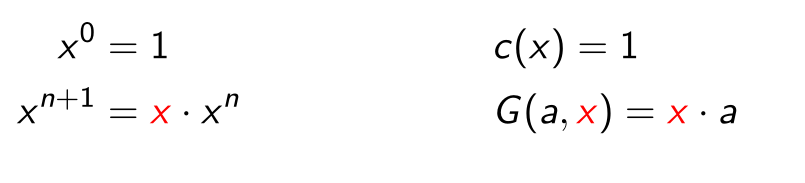
In the case of the factorial function, the \(n\) parameter can be useful as well:

(G should be defined as \(G(a, n) = n \cdot a\))
However, this does not allow all recursive function. For example, a the fibonacci function requires access to both the last and the second last value.
Recursive Value Recursion (“Wertverlaufsrekursion”)
A recursive value recursion is similar to a primitive recursion, with the key difference that \(G\) can access all past values instead of just the last one.
In theory, since finite sequences can be encoded as numbers, every recursive value recursion can be encoded as a primitive recursion.
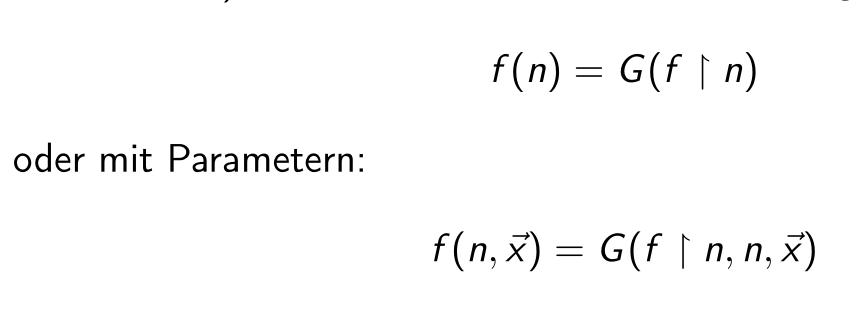
The following shows an example in haskell:
valueRec :: ([Integer] -> Integer) -> Integer -> Integer
valueRec g n = g [ valueRec g (n-i) | i <- [1..n]]

fib = valueRec g
    where
        g [] = 1
        g [_] = 1
        g (x:y:_) = x + y
General Recursion ("Allgemeine Rekursion")
If the schemes from above are not followed
Tail Recursion (Endrekursion)
A function is tail-recursive, if the last expression in every branch is the recursive call.
Accumulator Pattern
-- This is **not** tail recursive, because the last expression is (+)
sum_ :: [Integer] -> Integer
sum [] = 0
sum_ (x:xs) = x + (sum_ xs)

-- This is recursive
sumTR_ :: Integer -> [Integer] -> Integer
sumTR_ acc [] = acc
sumTR_ acc (x : xs) = sumTR_ (x + acc) xs
sumTR = sumTR_ 0

-- the following defines a factorial function, using the "accumulator pattern"
fakTR :: Integer -> Integer
fakTR = fakTR_ 1
    where
        fakTR_ :: Integer -> Integer -> Integer
        fakTR_ acc 0 = acc
        fakTR_ acc n = fakTR_ (n * acc) (n - 1)

-- the following is an power function
pow_ :: Integer -> Integer -> Integer
pow_ = powTR 1
    where
        powTR :: Integer -> Integer -> Integer -> Integer
        powTR acc _ 0 = acc
        powTR acc b e = powTR (b * acc) b (e - 1)

-- this is a second iteration that is slightly cleand up
-- (b has been pulled out of powTR)
pow_ :: Integer -> Integer -> Integer
pow_ b = powTR 1
    where
        powTR :: Integer -> Integer -> Integer
        powTR acc _ 0 = acc
        powTR acc e = powTR (b * acc) (e - 1)
The following is an example, where a Bool is used as an accumulator:
isPalindrome :: String -> Bool
isPalindrome w
    | l < 2 = True
    -- this is technically also a tail recursion, since && short-circuits
    | otherwise = w0 == wE && isPalindrome w'
    where
        l = length w
        w0 = head w
        wE = last w
        w' = tail $ init w -- w without the head or tail

isPalindrome' :: String -> Bool
isPalindrome' = isPalindromeTR True

isPalindromeTR :: Bool -> String -> Bool
isPalindromeTR acc w
    | l < 2 = acc
    | otherwise = isPalindromTR (acc && w0 == wE) w'
    where
        l = length w
        w0 = head w
        wE = last w
        w' = tail $ init w -- w without the head or tail
The fibonacci sequence needs two accumulator, since the last and second to last element has to be accessed.
fibs n
    | n < 2 = 1
    | otherwise = fibs (n - 1) + fibs (n - 2)

-- tail recursive
-- fibs 1 1 n is the base case for acc1 and acc2
fibsAcc acc1 acc2 n
    | n < 2 = acc1
    | otherwise = fibAcc (acc1 + acc2) acc1 (n - 1)
Continuation Pattern
At times it can be easier to represent the work that still needs to be done as a parameter. This is the difference between the continuation pattern and the accumulator pattern (where the computed value is represented as a parameter).
fakC :: Integer -> Integer
fakC = fakC_ ( const 1)
    where
        fakC_ f n
        | n < 1 = f n
        | otherwise = fakC_ (\ x -> n * ( f x ) ) $ n - 1
The following examples show why it can advantageous to use the continuation pattern instead of the accumulator pattern.
myMap :: (a -> b) -> [a] -> [b]
myMap f [] = []
myMap f (x : xs) = (f x) : (myMap f xs)

-- with the accumulator pattern
myMap' (a -> b) -> [a] -> [b]
myMap' f = myMapAcc []
    myMapAcc :: [b] -> [a] -> [b]
    myMapAcc acc [] = reverse acc -- the reverse is necessary since we add
    myMapAcc acc (a:ax) = myMapAcc (f a : acc) ax

-- with the continuation pattern
myMap' (a -> b) -> [a] -> [b]
myMap' f = myMapCont id
    myMapCont :: ([a] -> [b]) -> [a] -> [b]
    myMapCont cont [] = cont []
    myMapCont cont (a:ax) = myMapCont (\list -> cont (f x : list)) ax
    -- We have more flexibility in the lambda expression, since cont is not a recursive
    -- call
Fix Points
A fix point of a function \(F: X \to Y\) is where \(F(x) = x\).
As an example, the function \(id\) has a fix point for every argument. More graphically, the fix point of is where the graph of \(F\) crosses the diagonal.
A fix point function would be expF h = h . Importantly, \(h\) is a function and expF h is a partially applied function.
The following is fix point for a function f. It is essentially a recursion with out a base case. If applied to expF, then the base case of expF can be used by fix.
fix :: (t -> t) -> t
fix f = f (fix f)

-- alternatively, the type can also be expressed as following, where t = t1 -> t2
fix' :: ((t1 -> t2) -> t1 -> t2) -> t1 -> t2
fix' f x = f (fix f) x
For example:
fibs n
    | n < 2 = 1
    | otherwise = fibs (n-1) + fibs (n-2)

-- in the following example, every recursive call is replaced by `f`
-- This then yields the "Funktional" of fibs
fibF f n
    | n < 2 = 1
    | otherwise = f (n-1) + f (n-2)

-- to use fibF, it has to be applied to fix. This reintroduces the recursion
fix fibF = fibs
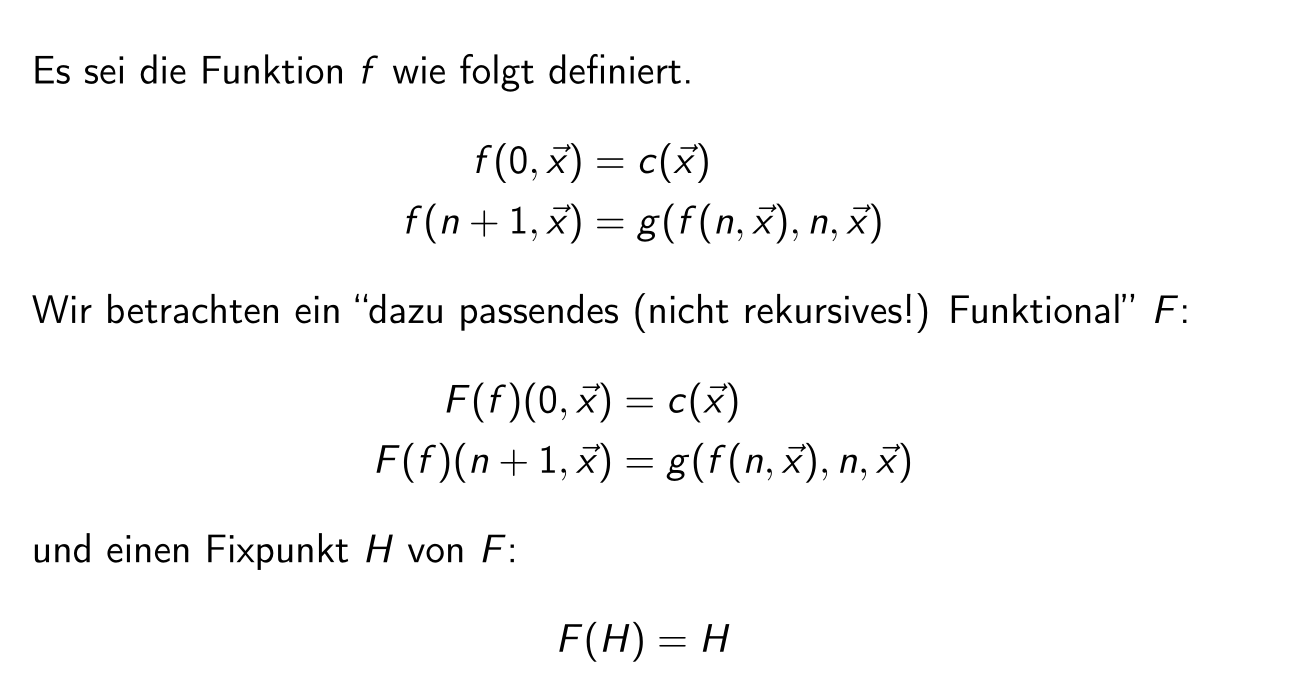
Even if Haskell didn't support recursion and would only support the fix function as part of the standard library, we still could write recursive functions using the trick above and the fix function.
The following shows why this works every time:
Memorisation
Memorisation can be implemented using fix points and a functional. An issue which arises with recursive function, is that the recursive call won't be memorisation. However, a functional isn't recursive by itself. Rather it uses a function passed as a parameter. This allows writing a memonisation function which inject itself into the recursive call.
General Fold
To generalise a fold function for a custom type T, the following steps can be followed:
- Analyse the type signature of the constructors of
T - Create function signatures for each constructor of
Twith the same parameters as the constructor. Instances ofTin the constructor should be rewritten to a type parameter. - Write a fold function, which takes a function for each constructor with the respective signature and an instance of
T
The following examples shows how a general fold function can be generated for the BTree type.
To create a fold, analyse each constructor
Then the fold function is