Functions
With BL mark the processor will jump to the given mark and store the address of the caller in the link register LR. With BLX Rx the processor will jump to the address in the given register and storing the address in the link register. When the subroutine is done, it can return with BX LR
                    BL  display_routine

display_routine
                    PUSH {LR}       ; save LR register
                    ; do display stuff
                    POP {PC}        ; restore LR register into the PC register
Stack
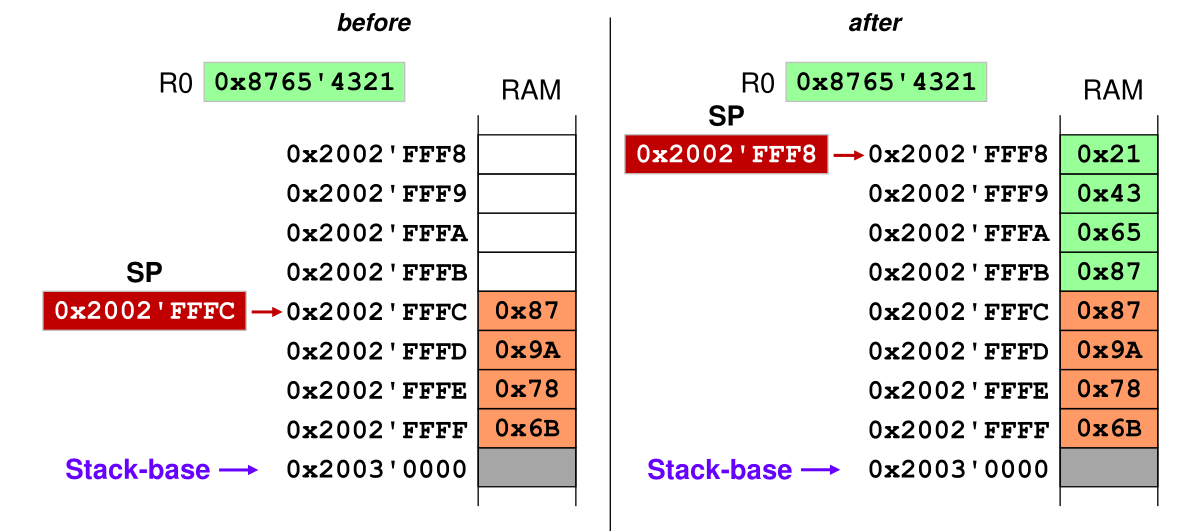
With PUSH can the contents of registers be pushed onto the stack. With POP can register be popped
The following example shows PUSH {R0}
Parameters
This tables shows the trade-offs of different techniques for passing a parameter. It also partly explains why AAPCS is designed in the way it is.
| Register | Global Variable | Stack | |
|---|---|---|---|
| Speed | ++ | -- | -- |
| Flexibility | -- | -- | ++ |
| Maintanance | -- | -- | ++ |
| Recursion | -- | -- | ++ |
Pass-by-value
AREA exData,DATA,...

AREA exCode,CODE,...

        MOVS R1,#0x03
        BL double
        MOVS ...,RO

double
        LSLS RO,R1, #1
        BX LR
Pass-by-reference
TLENGTH EQU 16

AREA exData,DATA,...
plTable SPACE TLENGTH

AREA exCode,CODE, ...

        LDR RO,=plTable
        MOVS R1,#TLENGTH
        BL doubleTableValues

doubleTableValues
        MOVS R2,#0

loop    LDRB R4,[RO,R2]
        LSLS R4,R4,#1
        STRB R4, [RO,R2]
        ADDS R2,#1
        CMP R2,R1
        BLO loop
        BX LR
Pass-by-global-variables
Pass-by-stack
ARM Architecture Procedure Call Standard (AAPCS)
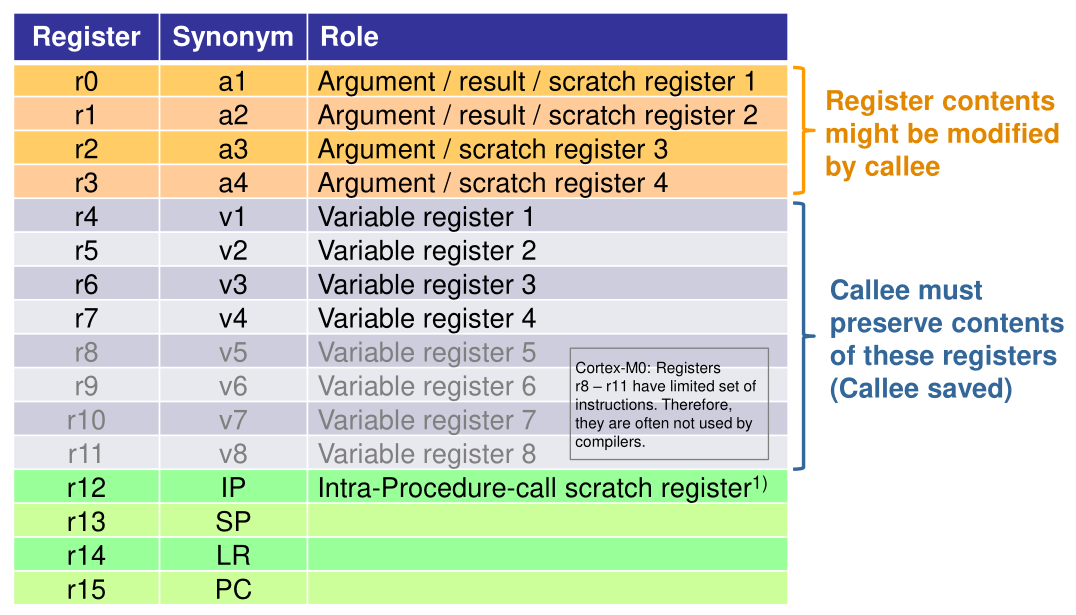
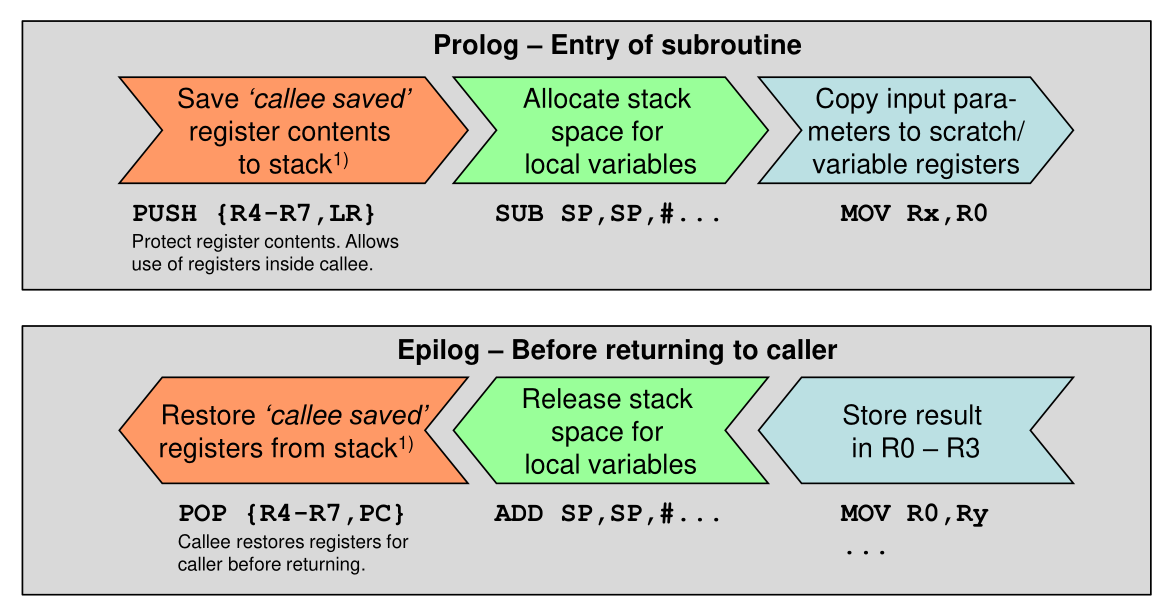
The registers R0 - R3 can be used for passing arguments or return values. The callee can change these. R4-R11 have to be preserved. If a function changes these then their original value has to be restored before the function jumps back.
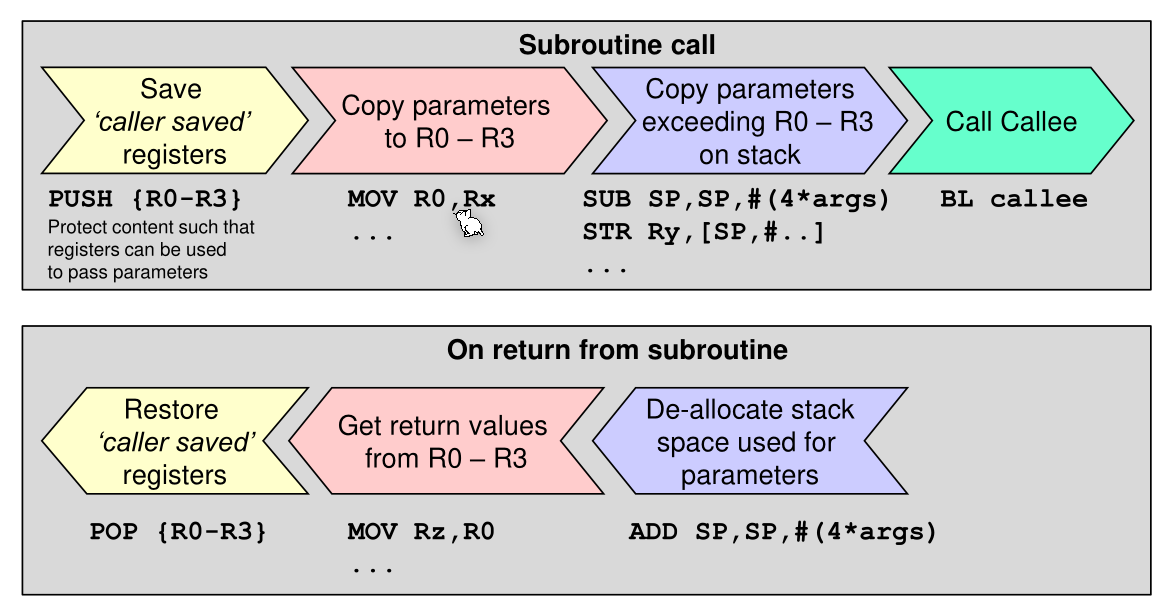
The caller has to do the following:
The callee has the following tasks:
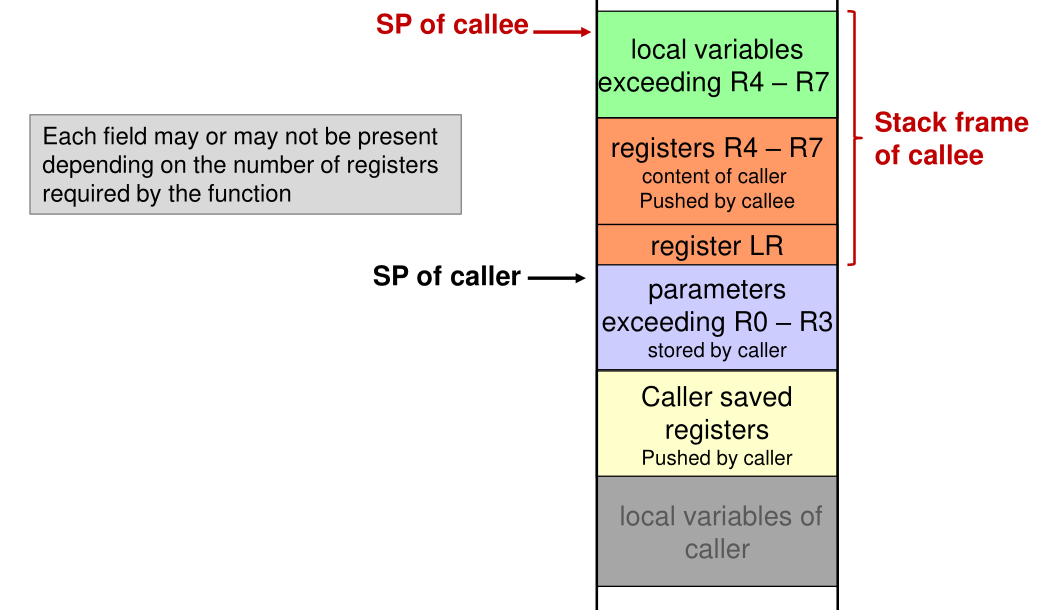
The stack might look like this if the contract specified above is met. A stack frame is a part of the stack