Instruction Selection
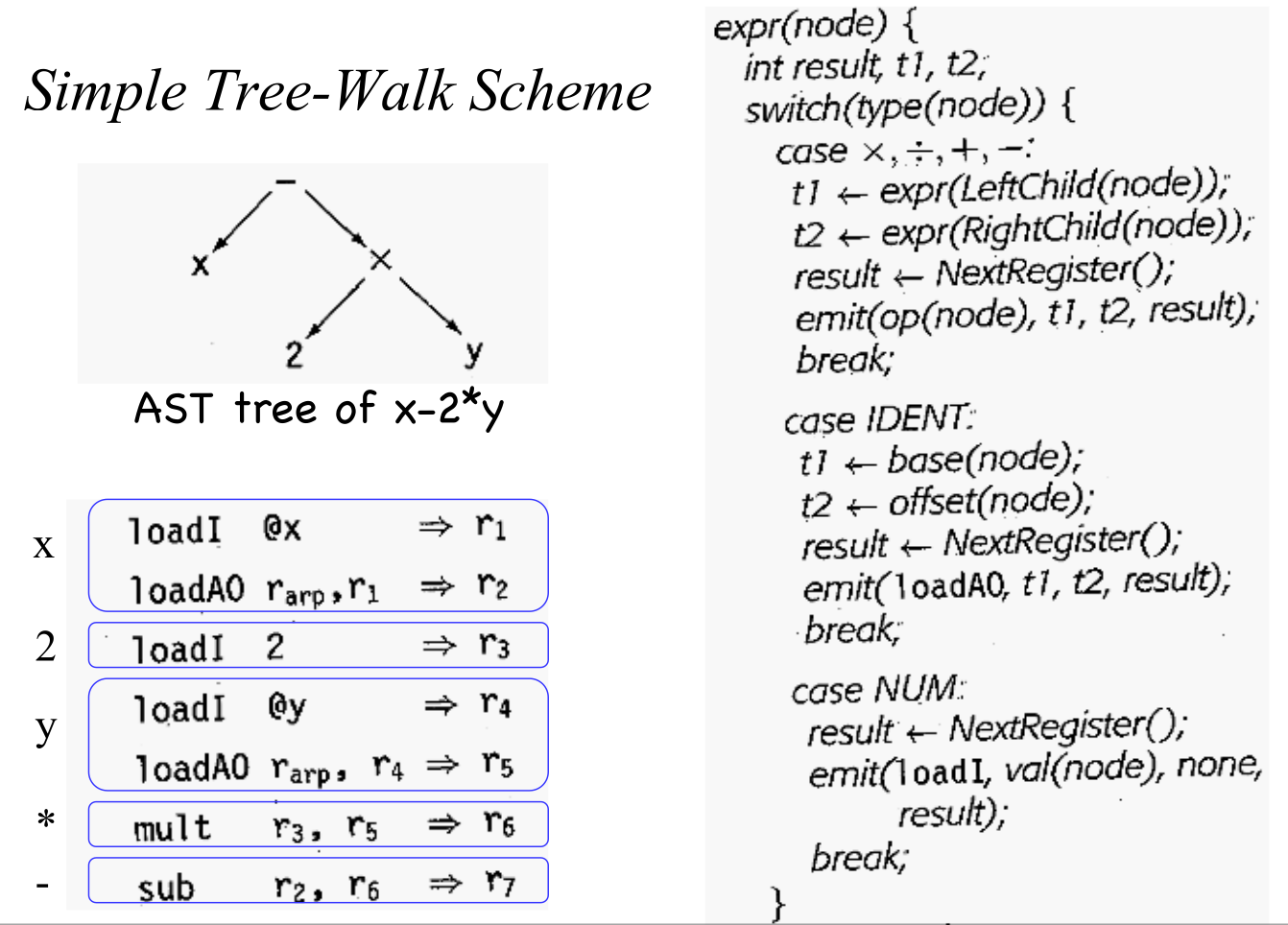
Tree Walk
By walking the AST and emitting the needed instructions for each node in the AST, wTe can generated the instructions with some simple code.
Rewrite Rules
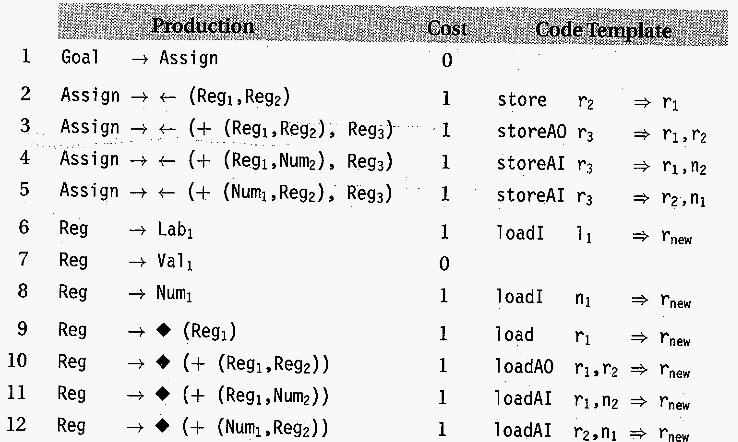
Examples:
Num 12->Reg(8);* (+(Lab, Reg))(14)
Num 12->Reg(8);(+(Lab, Reg))(19);*(reg)(9)
Lab @G->Reg (6);Num 12->Reg(8); ->+ (Reg, Reg)(15); ->*(Reg)(9)
The following algorithm finds all possible reductions:
TODO: check the tile algorithms
def tile(n):
    label[n] = {}
    if n is binary node:
        tile(n.left)
        tile(n.right)
        for each rule r:
            if r.op == n.op and r.let in label[n.left] and r.right in label[n.right]:
                label[n].push(r)
    else if n is unary node:
        tile(n.left)
        for each rule r:
            if r.op == n.op and r.left in label(n.left):
                label[n].push(r)
    else: # n is a leaf
        for each rule r:
            if r.op == n.op:
                label[n].push(r)
Peephole Optimisation
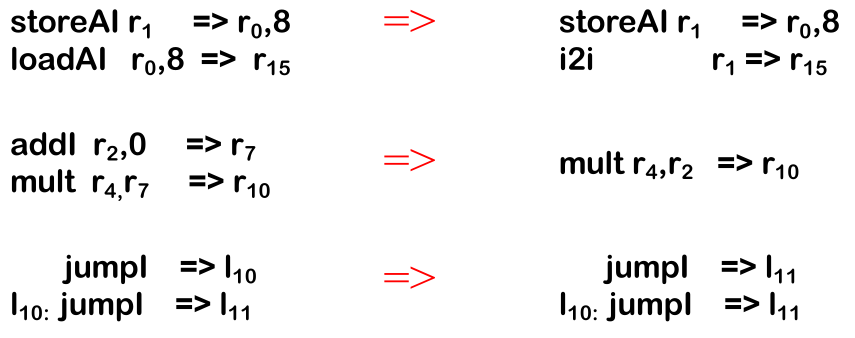
The basic idea is to have a sliding window, the peephole, which slides over the code. The re are rewrite rules, which match the instructions seen through the peephole and then rewrite them to a more efficient version.
This kind of optimisation provides local optimisations, since it can only see a small amount of code at a time.
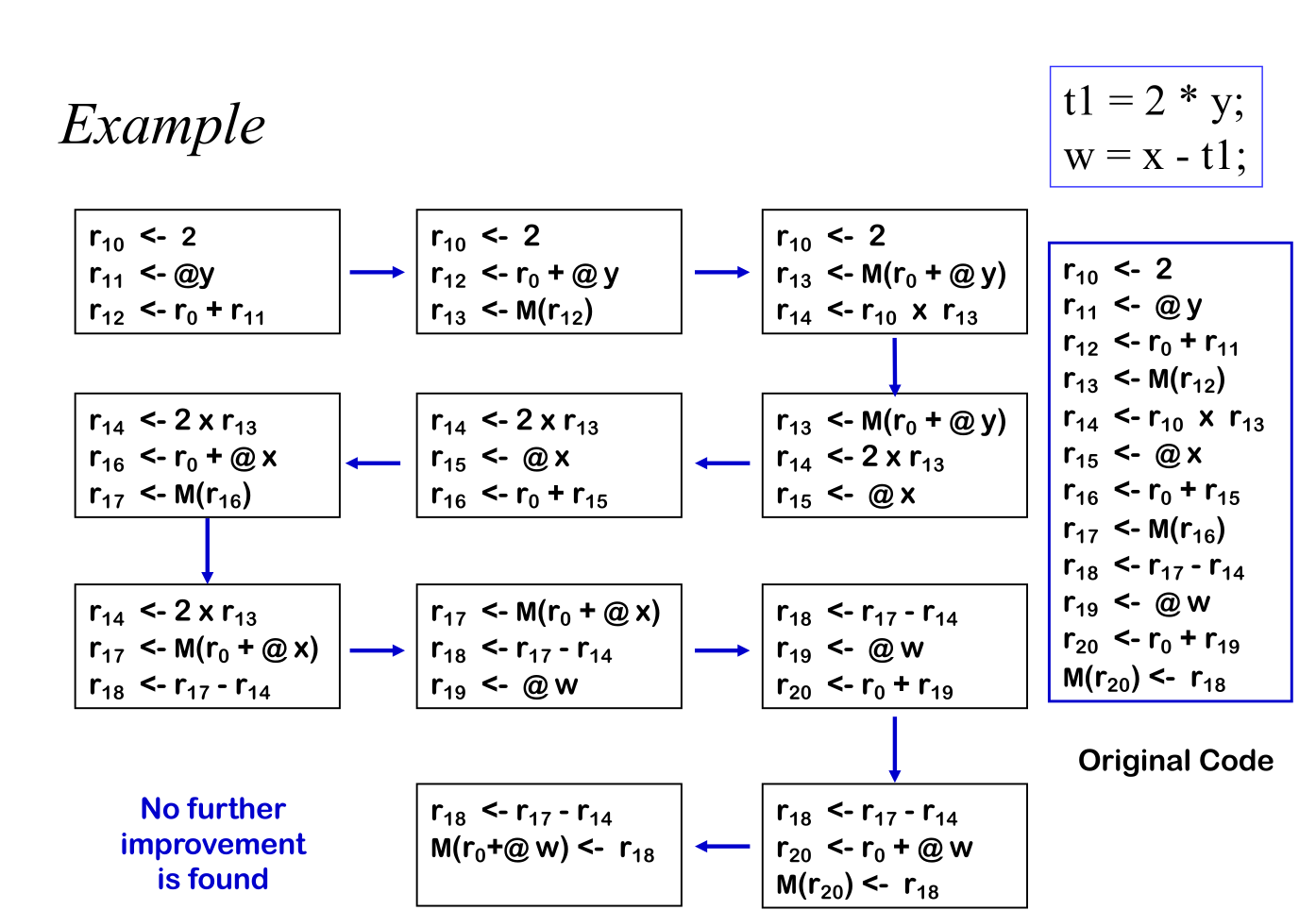
The following image shows the rule, with which the example is optimised with: