Extreme Programming
Extreme programming (XP) is a software development methodology intended to improve software quality and responsiveness to changing customer requirements.
Four Variables (Iron Triangle)
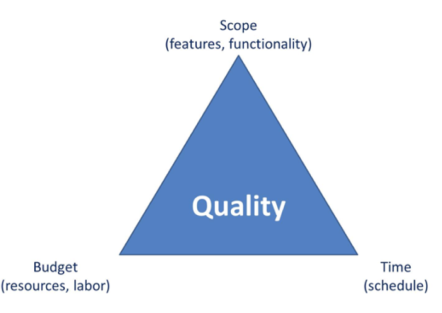
There are four variables, time, resources, quality and scope, to develop software.
In a traditional waterfall model, the resources, scope and time are fixed by a contract and the quality is implicitly set.
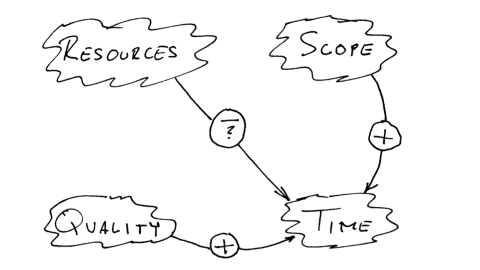
In agile development, the quality, time and resources are fixed, but the scope can be managed. Scrum does this by letting the customer choose the next features.
Cost of Change
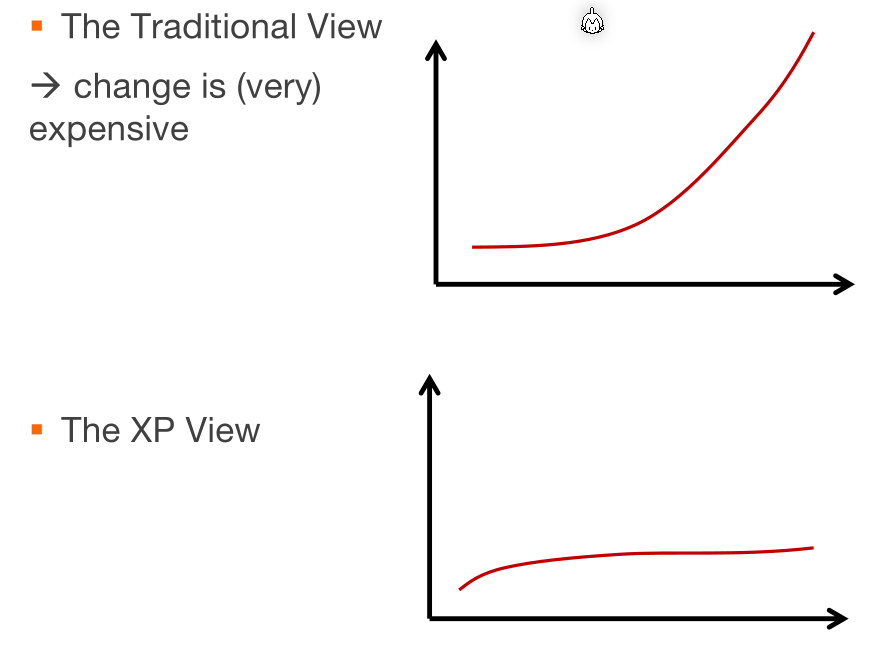
In a traditional waterfall model, change at a late stage is viewed as expensive. However, this doesn't necessarily hold true. Tools like, unit tests, refactoring and clean code (high cohesion, low coupling), help to keep the curve flat.
Values of XP
- Communication Everyone is part of the team and everything from requirements to code is worked on together.
- Simplicity Only do what is needed and asked for, but no more. Small simple steps should be taken (continuous integration) instead of big leaps to mitigate failure.
- Feedback Because releases are delivered regularly, the team can ask and listen to feedback and adjust accordingly. Another important take away, is to adjust the process to the project, not the other way around.
- Courage It's important to tell the truth about the progress and estimates.
- Respect Every member is given and feels respected. Importantly, also management respects the right of the team to the authority over the project.
XP Practices
The Planning Game
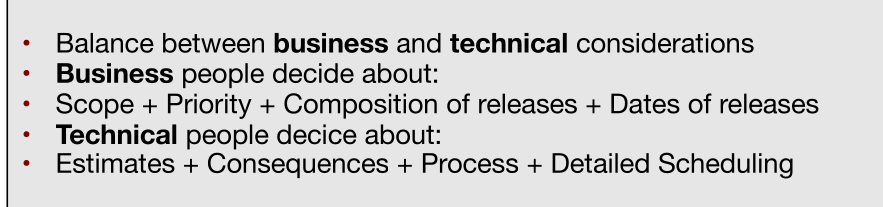
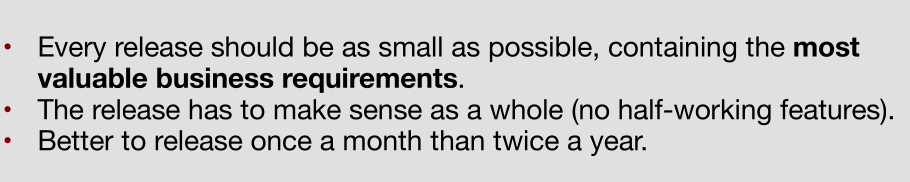
Small releases
Metaphor
At the beginning of the project a project vision is written so everybody has the same understanding of the project and its scope. This applies to technical and non-technical people.
(A metaphor translates to bildliche Beschreibung)
Simple Design
The right design for a software system is one that:
- Runs all tests
- Has no duplicated logic
- Has the fewest possible classes and methods
- Put in what is needed when it is needed
- Emergent, growing design (no big design upfront)
Testing
Any program feature without an automated test simply does not exist.
A development cycle exists of:
- Listen (requirements)
- Write the test
- Implement the changes
- Refactor
Refactoring
When implementing a feature, one should always ask themself if the code and architecture can be improved. Tests provide a safety-net which allows changes to be done without fearing bugs and crashes.
Pair Programming
XP dictates that all production code is written by two people looking at one screen. However, this is rarely being done in practice. It can be a useful technique to write the tricky parts of a software.
The pairs should change frequently.
Collective Ownership
Everybody takes responsible for the whole system. While not everybody can be an export in every system, everybody should know the basics.
Continuous Integration

40 hours week
Developing the software needs to be sustainable. This also means, that extended periods of overtime cannot exist.
On-site customer
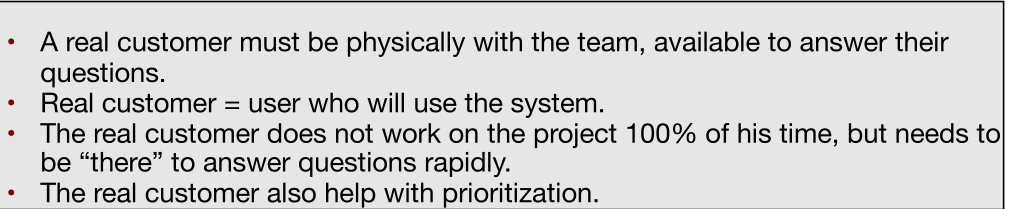
This hasn't materialised in practice, as the customer also has a job to do.
Coding Standards
Collective ownership + constant refactoring means that coding practices must be unified in the team.
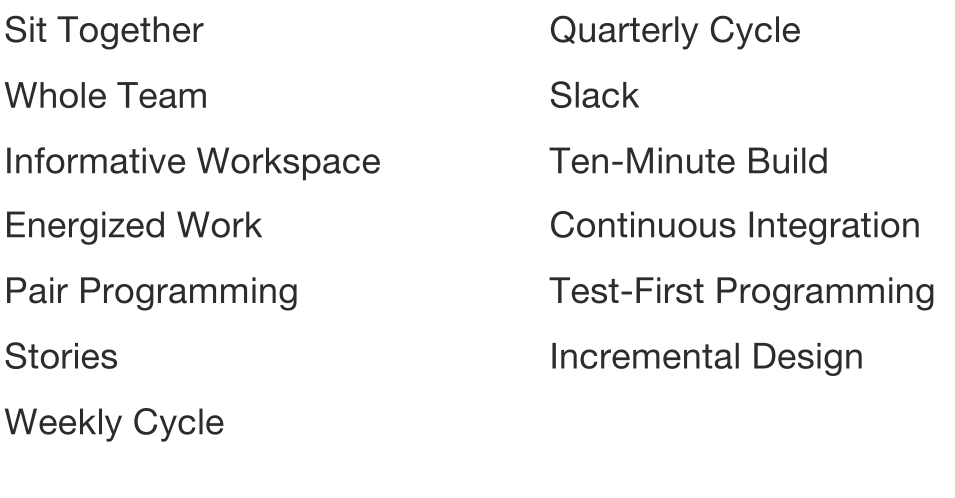
Primary Practicies
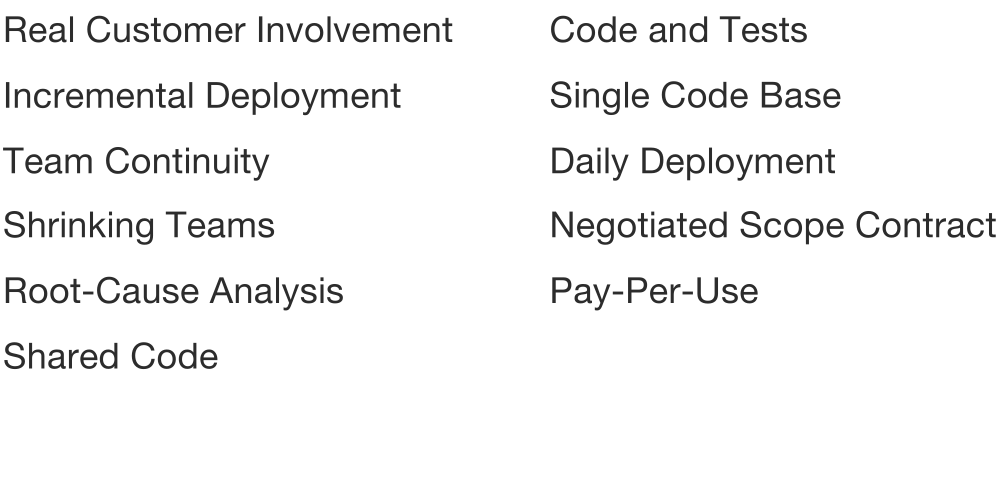
Corollary (=logische/folgende) Practices
Slack
Include some minor tasks, which can be dropped if the development team gets behind. This has the goal for establishing trust in the team's ability to deliver on time.
Incremental Design
Break a problem in small, compact problems instead of solving a big task and reducing waste.