Concurrency
Types of Concurrencies
There are multiple types of concurrencies:
- True concurrency On a computer with more multiple cores, each core can run a flow independently
- Interleaving concurrency Each flow gets a slice of time. After that time the flow will be paused and the core will work on another flow. The scheduler controls which core works on which flow
Strategies for Interlaving Concurrency
- Non-Preemptive (cooperative)
The process releases the core voluntarily Tyes: FCFS(First comes, first served), SNP(shortest process next). This was how it was in the olden days
- Preemtive A scheduler can interrupt a process
Program vs Process vs Thread
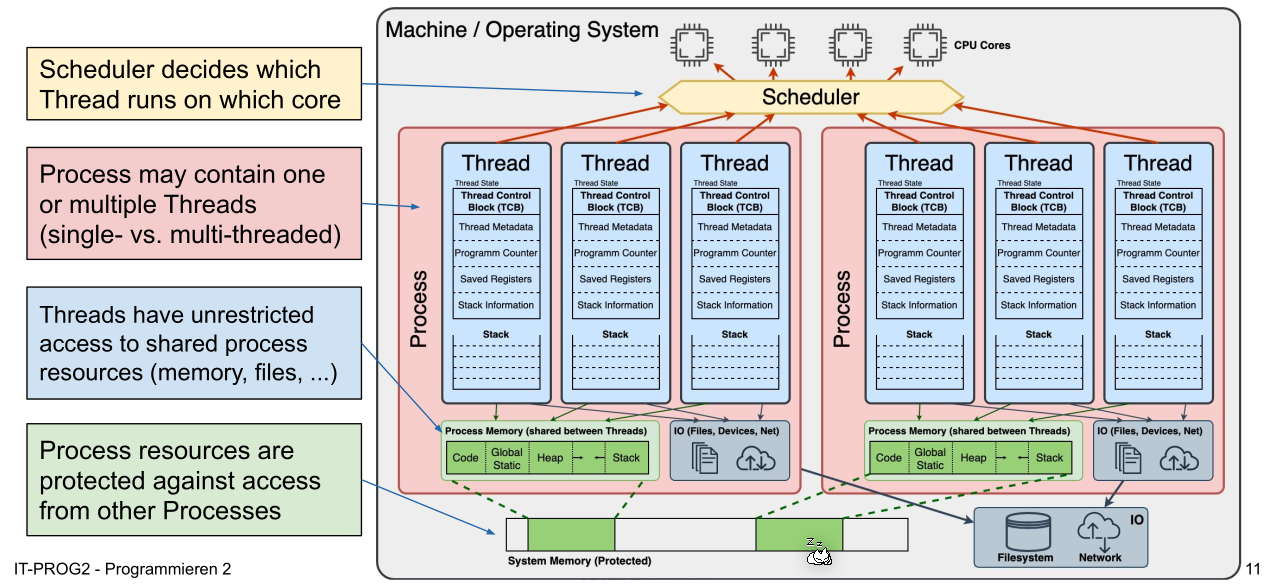
A program is a sequence of instructions and can consists of multiple processes.
A process executes a program or part of it and can consists of multiple threads. Each process has its own memory, uses IPC (Inter-Process-Communication) to communicate to other processes and switching between processes is expensive.
A thread is part of a process and runs one flow. It shares its memory with the other threads in the same process and switching between thread is cheap.
Java-Concurrency
Thread
Thread.sleep()doesn't gurantee that sleep doesn't wake up early or lateObject.yield()will advice the scheduler to release the thread, but there is guarantee that the thread will be suspened- With
Thread.currentThreadone can get the thread which runs the current thread Thread.stop(),Thread.suspend()andThread.resume()are depricated and potentialy unsafe
Lifecycle of a Thread
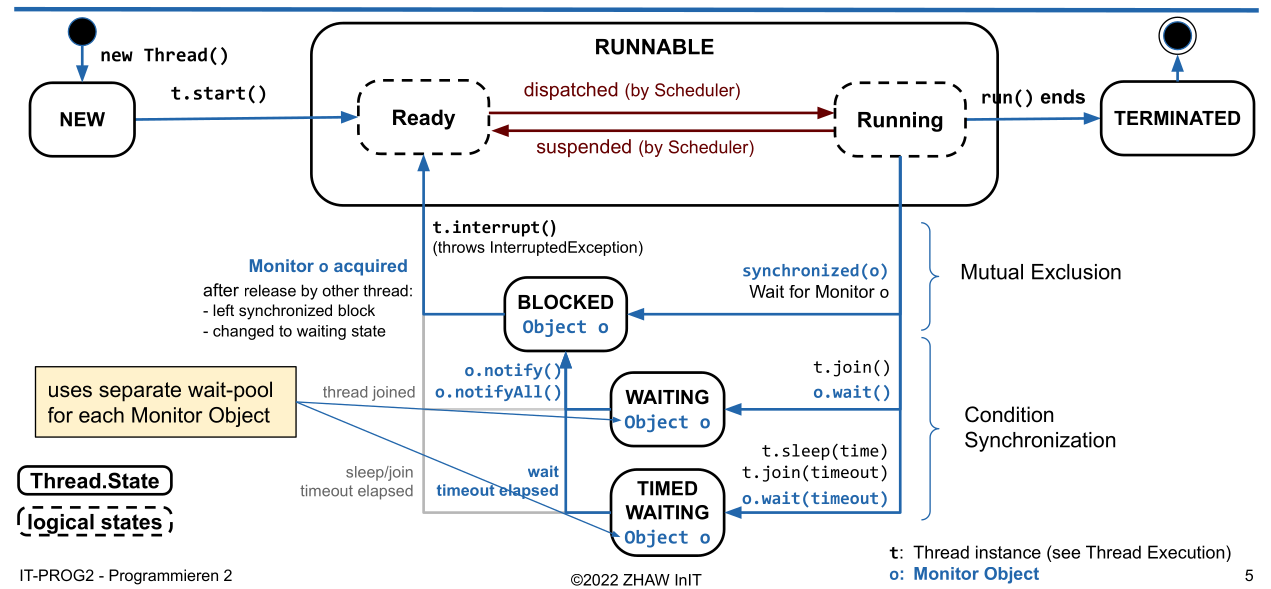
A Thread is considered "alive" and Thread.isAlive() will return true, when the Thread is either ready, running oder suspended (the blocks with the dotted outline). This means that run needs to start running before the Thread is alive.
Executor Framework
verify(behaviorModel, never()).setPosition(any());Executor Service
 An
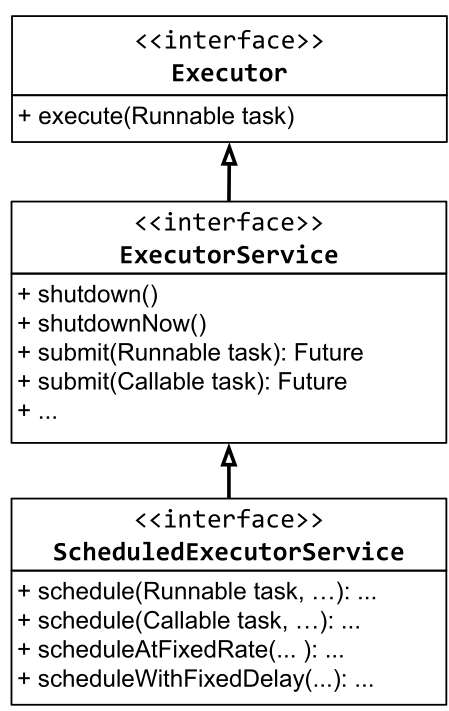
An Executor just promises to execute a given task.
An ExecutorService extends Executor to allow to shutdown the Executor and to track the progress and the state of a task. The shutdownNow() method uses Thread.interrupt() under the hood and is thus not deprecated.
The ScheduledExecutorService extends the ExecutorService to allow a task to be scheduled. The method signitures of the new methods are:
schedule(Runnable task, long delay, TimeUnit unit),scheduleAtFixedRate(Runnable task, long initialDelay, long period, TimeUnit unit)scheduleWithFixedDelay(Runnable task, long initialDelay, long delay, TimeUnit unit)
Thread Pools
A thread pool uses multiple threads which are reused for multiple tasks. Thread pools usually use a queue to hold the tasks to be executed.
A special kind of thread pool is a Blocking Queue, which when it's full, will reject newly submitted tasks.
Most Executor Services use thread pools underneath.
Different Executors
| Executor Name | Description |
|---|---|
Executors.newSingleThreadExecutor() |
Creates an Executor which only uses one thread |
Executors.newFixedThreadPool(int numOfThreads) |
Creates an Executor which has the given number of threads. Those thread will be reused |
Executors.newCachedThreadPool() |
Creates new threads as needed. It will retain Threads for an amount of time (approx. up to 60s) and will stop it after. |
Executors.newScheduledThreadPoool(int numOfThreads) |
Creates a new scheduled thread pool with the given number of threads. |
Executors.newSingleThreadExecutor() |
Creates a new scheduled executor with a single thread |