CNA Principles (12 Factor)
The following principles were developed by Heroku in 2011. See https://12factor.net/
1. Codebase
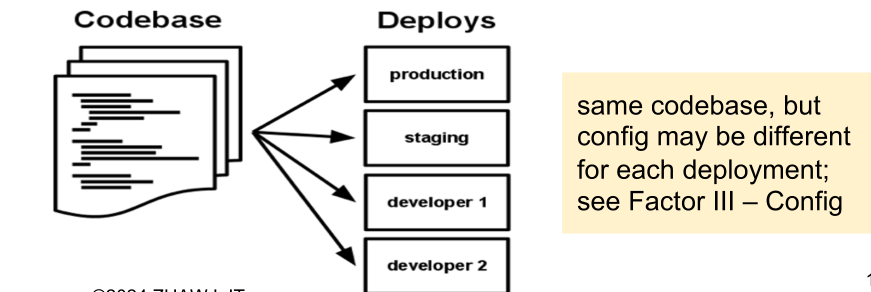
One codebase tracked in revision control, many deploys. Importantly, the same code base is used for each customer.
2. Dependencies
All dependencies are explicitly declared and are isolated (both are required). Thus the application cannot depend on system-wide dependencies. This simplifies the setup and avoids sudden surprises when external dependencies inevitable change.
Dependencies can be specified with different tools:
- Java: pom.xml for dependencies and the JVM for the isolation
- C: autoconf for dependencies and static linking for isolation
- In general: Dockerfiles for dependencies and container-images for isolation
- Alternatively, build automation (ansible, ...) for dependencies and VM images for isolation
In general, wildcard declarations should be avoided at all cost.
3. Config
Everything that's likely to change between deployments should be stored in an external configuration, and not configured in the code.
This likely includes:
- Resources like databases and other backing services
- Credentials to external services (e.g. Amazon S3, Twitter, ...)
- Per-deploy values (e.g. canonical hostname, ...)
These configurations are strictly separated from the code and are injected into the environment. 12-Factor recommends doing this with environment variables, since they are easy to change without changing code, and they are unlikely to be checked into a repository.
4. Backing Services

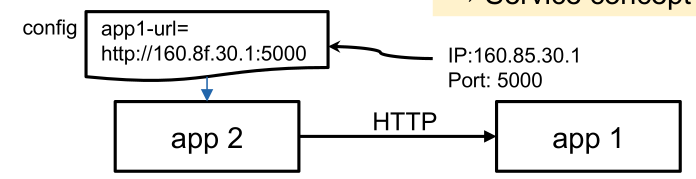
Backing services should be treated as an attached resource and need to be configurable as a URL. Importantly, no distinction is made between local and third-party services.
A backing service is any service the app consumes over the network during its normal operation (DB, monitoring, SMTP server, cache...)
5. Build, Release, Run

Building, releasing and running are separated stages. This enables building the image once, then putting it into testing. After testing, the image can be put into production.
This is most likely an artefact of the past, when it was common to directly upload files to the production server.
6. Processes
Services (processes) are stateless and share nothing.
- A service never assumes that anything is cached in memory or on disk. This enables that a request can go to any instance, since the instance didn't cache anything
- Any persistent data must be stored in a stateful backing service
7. Port Binding
A service is completely self-contained and does not rely on the presence of a webserver in the environment.
A service can become the backing service for another app. Then the backing service's URL is provided to the service using the service.
8. Concurrency
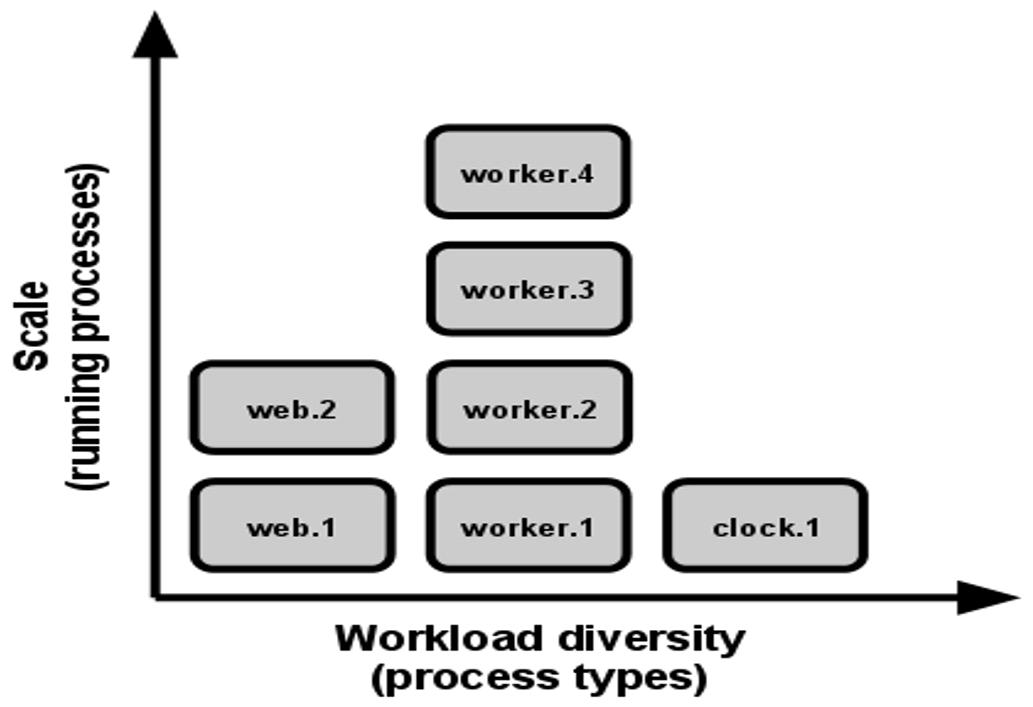
Each server can scale individually and horizontally (adding more instances).
9. Disposability
A service needs to be able to start and stop at any time. When receving a termination signal (e.g. SIGTERM), resources should be freed, the service should unsubscribe from message channels and locks should be released.
Additionally, the app should be robust against sudden death, in the case of a failure of the underlying hardware.
10. Dev/Prod Parity
Development, staging and production environment should be as similar as possible. This enables effective continuous delivery and deployment and avoid gaps between development and production.
- Avoid time gap: Write code and have it deployed within hours
- Avoid personnel gap: developers who wrote code are closely involved in deploying it and watching its behaviour in production
- Avoid tool gap: Use the same tools in development and production
11. Logs
Logs should be treated as event streams.
A service should never concern itself with routing or storage of its log output stream. Instead, the environment captures the logs and collated them together for viewing and for long-term archival.
12. Admin Processes
Management tasks (e.g. deployment or modifying DB structure) are executed as a one-off service and not part of the long-running services. Thus, services don't do migration themselves, since this could lead to disaster when the other replicas still require the old DB structure.
These tasks should be tested on a copy of the environment with the same release, codebase and config.