Notes 06. September 2023
Topics that were alluded to:
- Closure
- Memory representation & GC
- Safety
Syntax is the UX of a programming language, and there are multiple design issues:
- Consistency
- Familiarity: JS is arguably popular because it looks like C/Java even though it works vastly differently
- Things that are related should look alike If things work similar, they should look similar. Otherwise, people could confuse the concepts
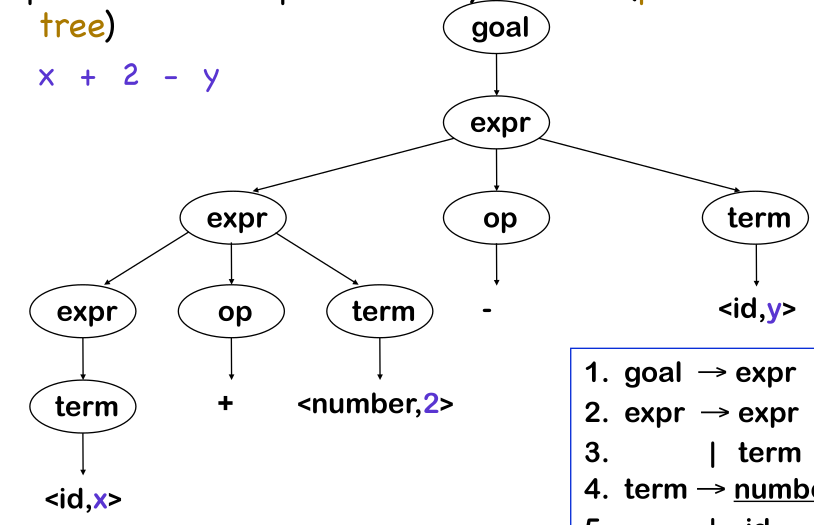
An Abstract Syntax Tree (AST) is a "cleaned-up" version of a parse tree. A parse tree is an exact representation of the source code (for example, a comment might be in the parse tree).
The following is a parse tree:
The expression
a * b + cwould be turned into the following ASTflowchart add(+) --> mul add --> c mul(*) --> a mul --> bAn interpreter might evaluate this tree by walking the tree in a post-order.
As a side note, this parse tree assumes that the grammar knows the precedence of the operators. There is an algorithm from Dijkstra called shunting yard, which takes a straight parse tree (without respect to the precedence) and the precedence of the algorithm and produces a parse tree which respects the precedence.
About the Essay of Syntax Design
A programming language gives us a way to structure our thoughts.
When we start to program a solution for a problem, at some point often notice that we weren't thinking precise enough and missed edge cases. A way to think about programming is, that it is a way of thinking in a way that the computer can understand the thought.
Most current popular programming languages are text-based. Every so often, there is a push towards visual programming languages. An example would be scratch. Another example would be showing an AI what to do, which then will "program" the source code.
S-Expression
(function :f (params :x :y)
    (block
        (var :b 3)
        (if (< x (* a (+ b 7)))
            (while found
                (block
                    (for :i (range 2 5) (print i))
                    (if (== a 2) (break))))
            (= p (cos 5)))
        (return (/ a 5))))
One quirk of s-expression is that the operator always comes first (like (+ 3 2)). However, this makes math look weird. For example, \((a \cdot b) + c\) would be (+ (* a b) c). One benefit of this, is that the work for the parser is straightforward since there are no precedence rules. This syntax is also called "prefix" syntax.
Postfix Syntax
There are also languages which use a postfix syntax.
The code above is equivalent to \((a \cdot b) + c\). First the a and the b are pushed onto the stack, ...
The compiler/interpreter for forth (or similar languages) can be minuscule, since they don't have to build the syntax tree, since the programmer already puts in the correct order.
[ :x param :y param ]
[
    3 :b var
    x a b 7 + * <
    [
        found
        [
            :i 2 5 [i print] for
            2 a == [break] [] if
        ]
    while]
    [5 cos p assign]
    if
    a 5 / return
] :f function
Indentation and Curly Brackets
Most programming languages use curly brackets. However, there are quite a few languages which use indentation (like Python or Haskell)
Semantics
Semantics is what a program-construct (e.g. a+b or x = a + b, {...}) means/what it does.
The code 4 + "1" could be interpreted differently. The following semantics are possible ways how the semantics of 4 + "1" could look like:
- It could produce
"41" - It could produce
5 - It could throw an error
- Many other possibilities
(On the note of weird JS quirks: https://jsfuck.com/)