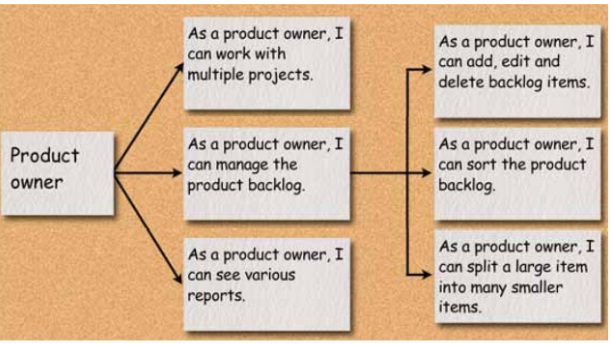
User Story
A user story is a concise description of a functionality which brings value to the user. It can follow the following template:
As a
[user role], I want to[goal]so that[benefit].
User stories are written during the sprint planing when all members of the teams are present.
User stories are not:
- Written contracts
- Requirements the software has to fulfill. Not every story gets implemented
- They do not need to include all details
- Too many details give the false impression of completeness. It is still necessary to talk to the customer
Additional information can be supplemented in small sub-stories.
The three Cs
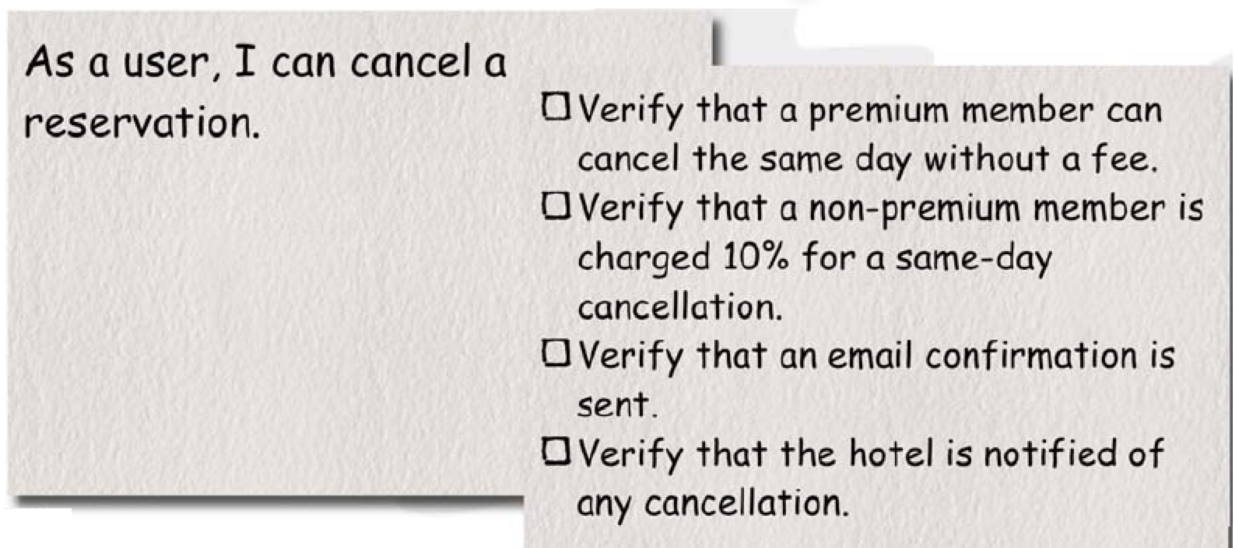
- Card User stories are traditionally written on note cards which may be annotated with estimates, notes, etc
- Conversation The actual details behind the user story come out during the conversations with the product owner
- Confirmation Often acceptance tests are written on the back
Non Functional Requirements
Non functional requirements can be formulated as special user stories if they can be worked on and then are done. If this isn't possible, then it can be written to the definition of done.
"The server needs to answer in 10ms" would be written in the definition of done as it is a never-ending story. On the other hand, "The webpage needs to be ported to a different server" could be formulated as a user story.
Spike
A spike or a knowledge-acquisition stories is a user story with the goal of generating knowledge for the developers. It is usually limited to a max time (timeboxed)
As a developer I want to prototype two alternatives for the new filtering engine so that I know which is a better long-term choice.
Condition of Satisfaction
These are criteria which need to be fulfilled for the customer to be satisfied. The customer will likely test these conditions.
The acceptance tests are the subset of the condition of satisfactions which can be technically checked. As an example, "the app needs to be able to refund a booking" can be objectively tested, while "The app needs to be beautiful" can't.
Termology
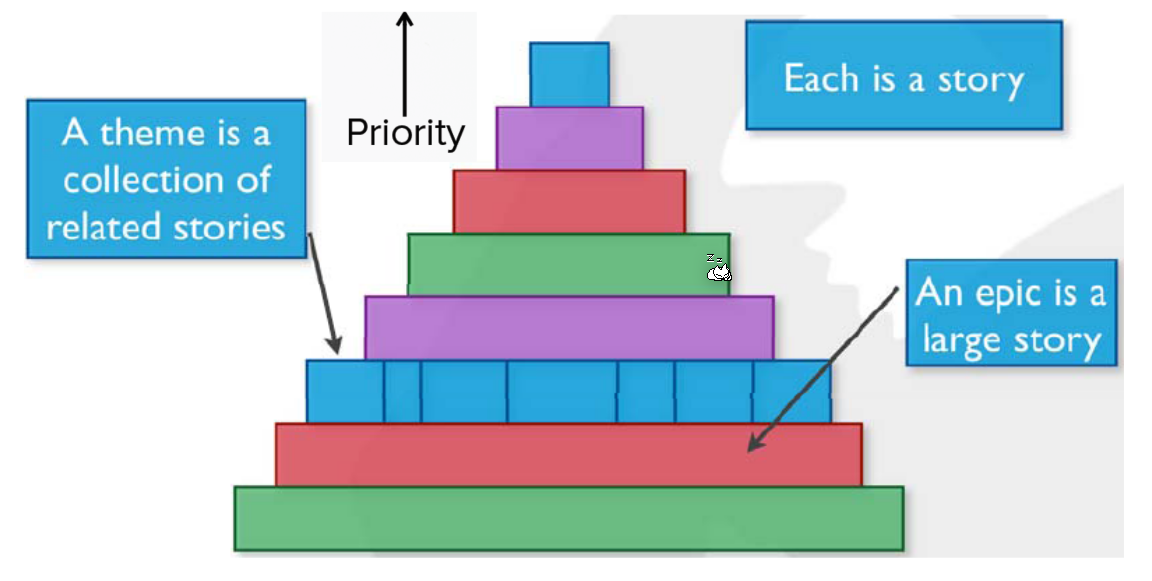
- User Story
- Theme A collection of user story, like "Multiplier". These can be initially used to create user stories by first listing themes and then generating the user stories.
- Epic A large user story
User Roles/Personas
While developing the team shouldn't think of "the user", but rather of multiple user roles.
How to find User Stories
Importantly, all members of the team, the customer, user and other affected people are present. First, the goal is just to generate as many user stories as possible without priorizing them.
Large user stories should be sub-divided into smaller user stories.