Erweiterte Konzepte
Object Initializers
class Student {
    public string Name;
    public int Id {get; set;} // setter muss öffentlich sein

    public Student(string Name) {
        this.Name = Name;
    }
}

Student s1 = new Student("John") {Id = 3};
Anonymous Types
oder sogar kürzer:
Extension Methods
class Fraction {
    public int z, n;
    public Fraction(int z, int n) {...}
}

static class FractionUtils {
    public static Fraction Inverse(this Fraction f) {
        return new Fraction(f.n, f.z);
    }
}
Die Klasse, in welcher die die Extension Methode enthält muss als static deklariert werden. Die Extension-Method selbst muss selbst auch static sein und der erste Parameter muss mit this annotiert werden.
Dass FractionUtils zieht, muss die Klasse importiert werden.
Lambda
delegate int FunctionName(int x);

void Apply(FunctionName f, int[] data) {
    for(int x : data) {
        f(x);
    }
}

Apply(x => x + 2, array);
Mit weniger oder mehr argumente ist es folgendermassen:
Lambdas in C# können auf den Scope, in welchem sie definiert wurden, zu greiffen;
Delegates können auch generisch sein:
Es gibt vordefinierte Delegate-Typen:
delegate void Action ();
delegate void Action<T1> (T1 a);
delegate void Action<T1, T2> (T1 a, T2 b);
delegate void Action<T1, T2, T3> (T1 a, T2 b, T3 c);

delegate TRes Func<TRes> ();
delegate TRes Action<T1, TRes> (T1 a);
delegate TRes Action<T1, T2, TRes> (T1 a, T2 b);
delegate TRes Action<T1, T2, T3, TRes> (T1 a, T2 b, T3 c);
LINQ
string[] cities = {...};

IEnumerable<string> result =
    from c in cities
    where c.StartsWith("B")
    orderby c
    select c.ToUpper();

IEnumerable<string> result2 = students
    .Where(c => c.StartsWith("B"))
    .OrderBy(c => c)
    .Select(s => new {s.Id, s.Name});
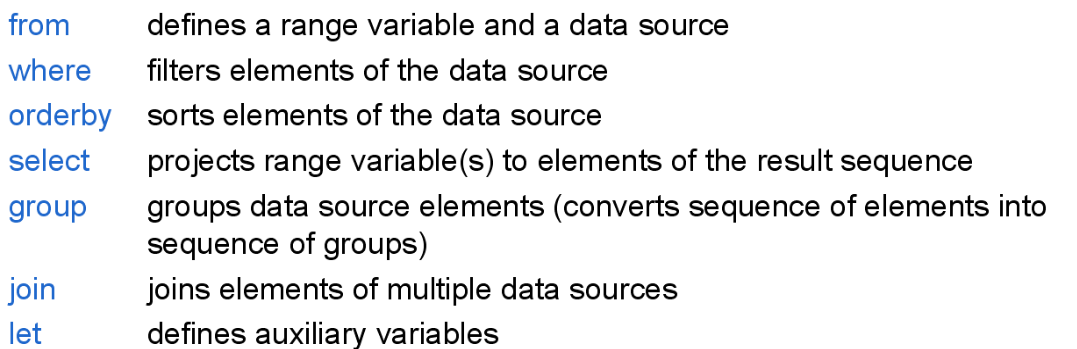

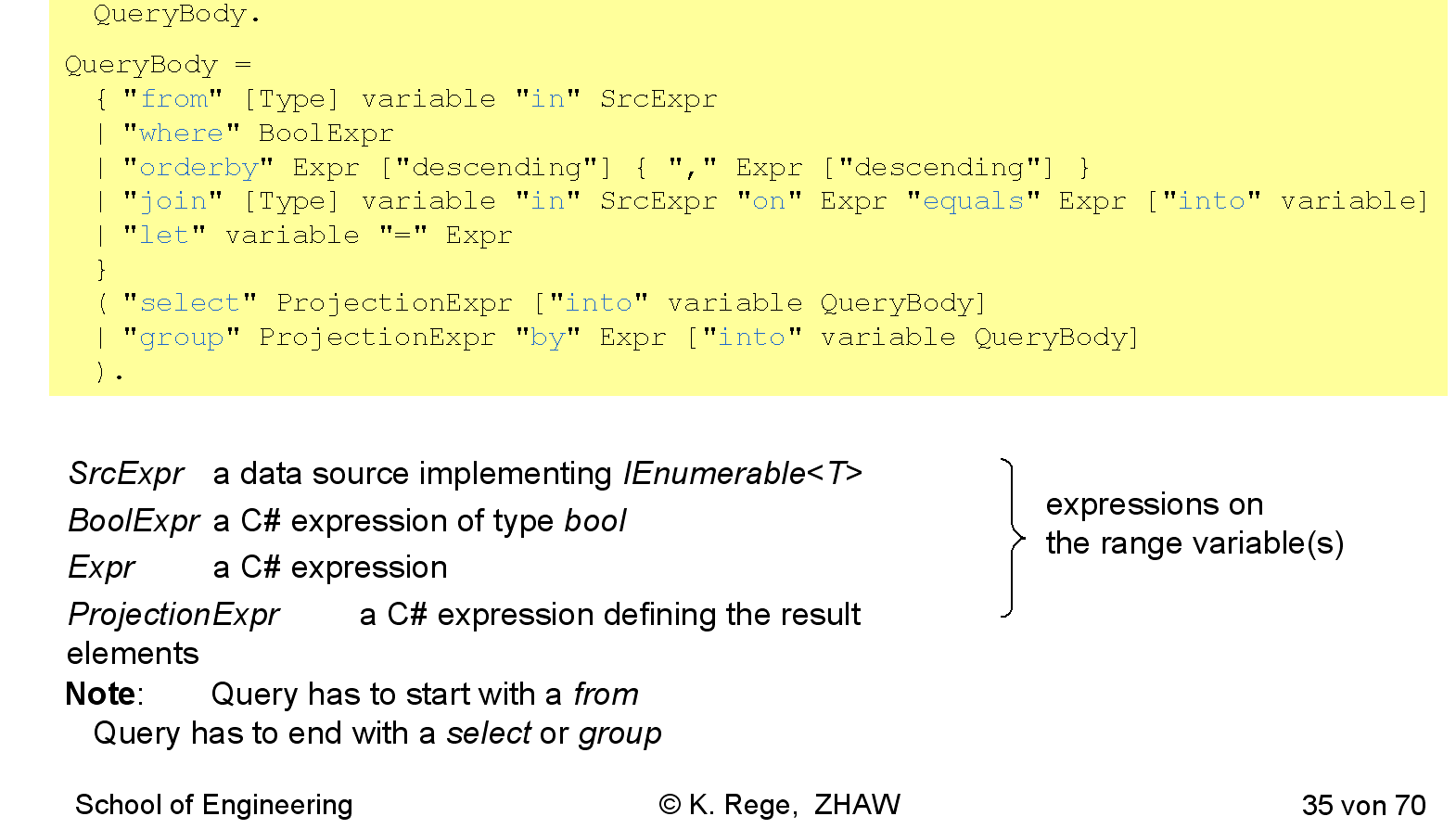
Mit LINQ können auch XML Elemente generiert werden, wie auch auf DataSets.
dynamic Typ
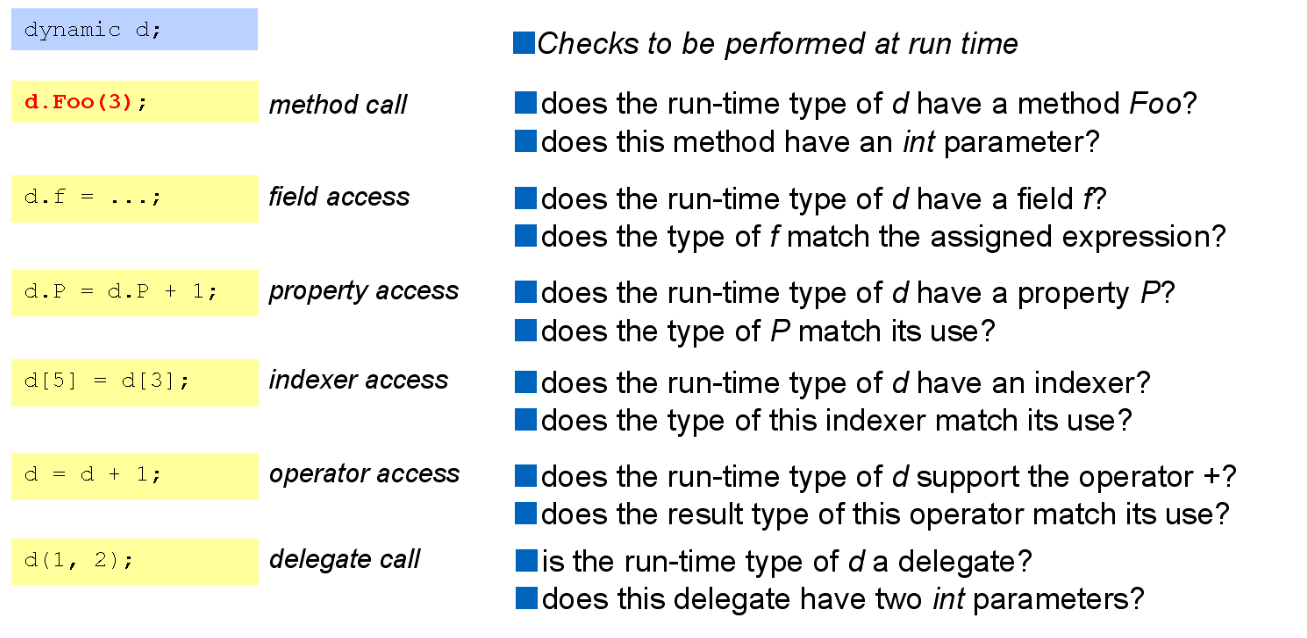
Eine Variable vom Typ dynamic kann jeden Typ beinhalten und kann auch jederzeit geändert werden. Bei Compilezeit wird die Typ-Sicherheit abgeschaltet.
Reflection
Type t = d.GetType();
if(t is a .NET type) {
    MethodInfo m = t.GetMethod("Foo", new Type[]{typeof(int)});
    if(m == null) throw new Exception(...);
    m.Invoke(d, new Object[]{3});
}
Covariance
In diesem Fall darf den generischen Parameter T nur als Rückgabe-Typ verwendet werden.
interface Sequence<out T> {
    T this[int i] { get; }
}

Sequence<String> stringSeq = ...;
Sequence<Object> objSeq = stringSeq;
Die alternative ist Kontravarianz:
interface IComparer<in T> {
   int Compare(T x, T y);
}

IComparer<Object> objectComp = ...;
IComparer<String> stringComp = objectComp;
Nullable
Nullable<double> = pi = 3.14;
double? pi = 3.14; // shorthand for Nullable<double>
if(pi.HasValue) {
    pi.Value + 1;
}
double pi2 = pi ?? 1; // if pi is null, 1 is returned

// with NullableContextOptions enabled
string? str = null;
string[]? splitted = str?.Split(",") //Only calls Split, if str is not null, otherwise null is returned
Per Default (aktuell) können primitive Typen Nullable gemacht werden mit dem Fragezeichen (e.g. int?).
Wenn NullableContextOptions auf enabled gesetzt wird, dann gibt es eine Warnung, wenn ein Referenz-Typ ohne Fragezeichen (z.B. string) null zuweist. Ebenfalls gibt es eine Warnung, wenn auf ein nullable Referenz-Typ zugegriffen wird, ohne das überprüft wird, ob es null ist.
Tuple
Neben den normalen Tuples (z.B. (3, 2)) können auch named Tuples erstellt werden:
Deconstruction
Eine eigene Klasse kann auch dekonstruiert werden:
public struct Complex{
    public double re;
    public double im;

    public Complex(double re, double im) {...}

    public void Deconstruct(out double re, out double im) {
        re = this.re;
        im = this.im;
    }
}

Copmlex c = new Complex(3, 2);
var (x, y) = c; // allows deconstructing of custom struct/classes
Imports
C# hat static imports:
//alows using all methods in System.Console with specifying Console
using static System.Console;

using AliasToMyClas = NameSpace1.MyClass;

WriteLine("Hello, Test");
new MyClass();
Default Interface Methoden
Records
records Person{
    public string? FirstName {get; init; }
    public string? LastName {get; init; }
}

var person = new Person { FirstName = "mads", LastName = "Nielson"};
var otherPerson = person with { LastName = "Torgesen" };

var name = person.FirstName;
C# generiert automatisch eine Equal methode.
Threads
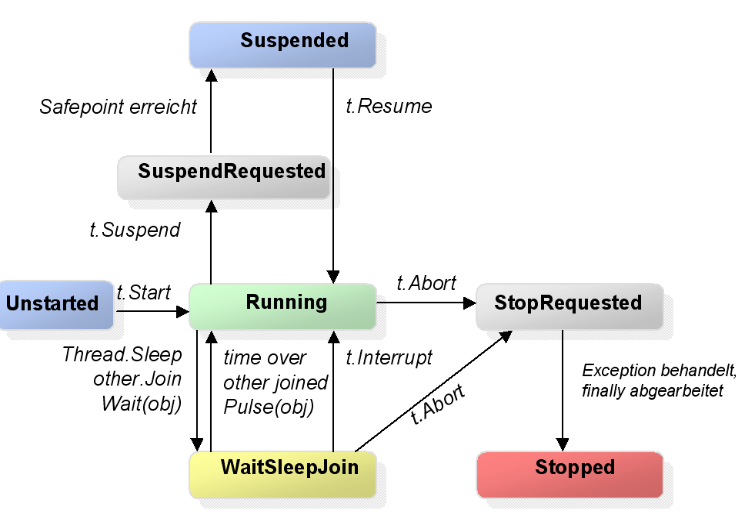
Threads sind teuer, zum erstellen, zum laufen und zum zerstören, da bei allem ein Mode-Switch vernöten ist. Zusätzlich, wenn der aktive Thread gewechselt wird, dann gibt es zusätzlich noch ein Context-Switch.
Coroutines
Courtines geben die Kontrolle aktive selbst ab. Dies hat den Vorteil, dass es keinen Kontext und Mode-Switch benötigt. Dies kommt mit der Einschränkung, dass dies nicht Preemptive ist.
class MyClass : IEnumerable<string> {
    public IEnumerator<string> GetEnumerator()
    {
        yield return first;
        yield return second;
        yield return third;
        yield break; // specifies that the enumerator is finished
    }
}
Tasks
Task task = new Task(() => ...);
task.Start();

Task.Run(() => ...); // creates and runs the task

Task<string> task2 = Task.Run(() => "Hello");
Console.WriteLine(task2.Result); // Result blocks until task2 is done

Task.Delay(1000).Wait();

task2.ContinueWith(t => Console.WriteLine(t)); // is exectued after task2 completed
// ContinueWith calls the lambda even if task2 is already
//done when ContinueWith is executed

// alternatively it can be written with await:
async static void CallerWithAsync() {
    // await starts (if not already started) and waits for the task to finish
    String result = await Task.Run(() => "Test");
    Console.WriteLine(result);
}

Task<string> task3 = Task.Run(() => "test");
// returns a Task which completes once all the given Tasks finished
string[] all = await Task.WhenAll(task3, task2);

// returns a Task which completes once one of the given Tasks finished
string first = await Task.WhenAny(task3, task2);
Eine Methode, welche ein Task startet, enden nach Konvention in Async (z.B. GreetingAsync(...))
Ein Task kann folgendermassen gecancled werden:
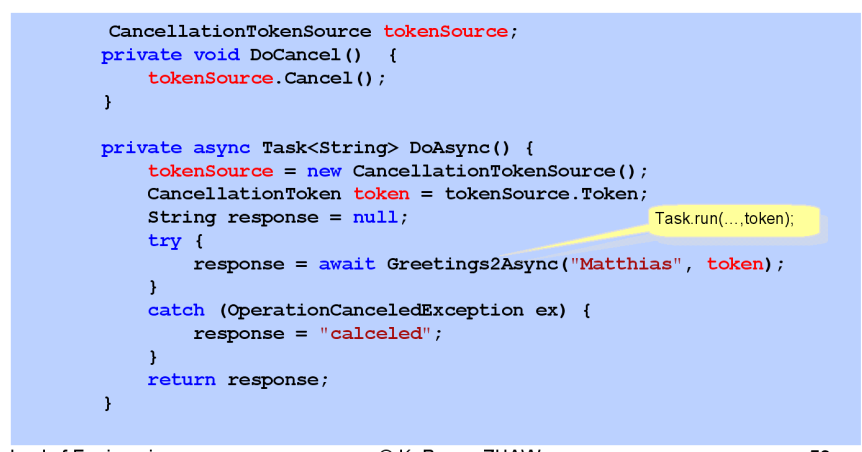
Mit Timeouts
var task = Task.Run(() => ...);

bool isCompletedSuccessfully = task.Wait(TimeSpan.FromMilliseconds(3000));
if(completedSuccessfully) {
    return task.Result;
} else {
    throw new TimeoutException("");
}

// alternative
var result = Task.WhenAny(task, Task.Delay(3000));
if(result == task) {
    return task.Result;
} else {
    throw new TimeoutException("");
}
Control Flow
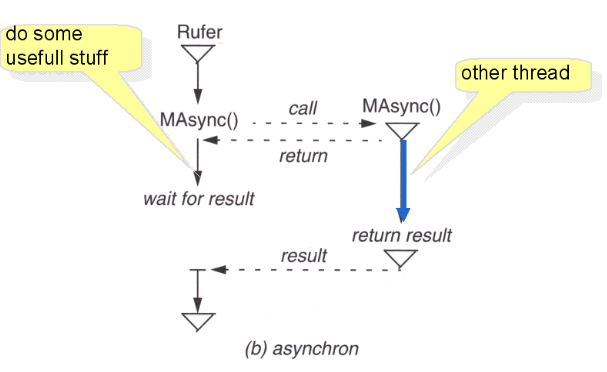
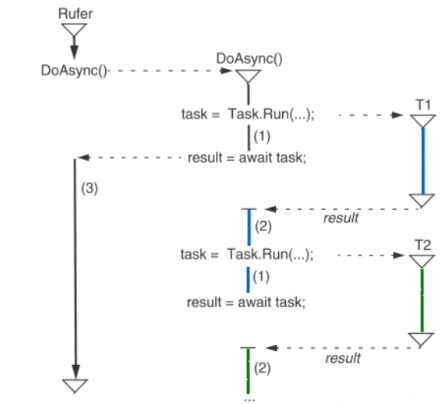
Ein interesanteres Beispiel ist das folgende: Da DoAsync() mit await task blockiert wird, wird die Kontrolle über den Thread wieder an den "Rufer" zurück gegeben. Wenn jetzt task fertig ist, dann wird ein "coroutine transfer" durchgeführt. Dies heisst, dass asynchrone Methode können von unterschiedlichen Threads bearbeitet werden.
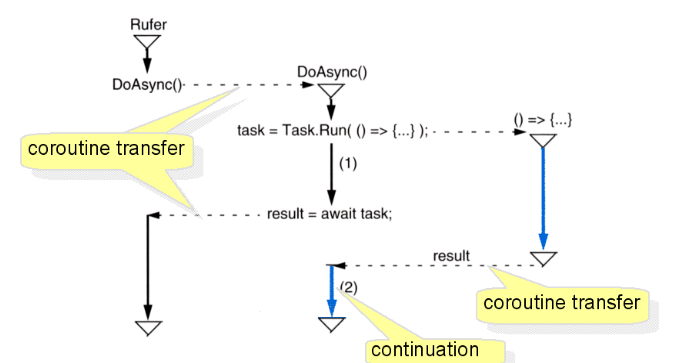
Das wird für folgenden Code noch extremer:
Pitfalls
Tasks benützt Background Threads. Dies heisst, die Applikation kann schliessen, obwohl noch Tasks am laufen sind.
Ein zweiter Pitfall ist, dass Exception verpuffen, wenn nicht auf den Task gewartet wird.
async void DoAsync() {
    throw Exception();
}

DoAsync(); // without await, Wait(), or accesing Result. This won't throw an exception
await DoAsync(); // will throw an exception
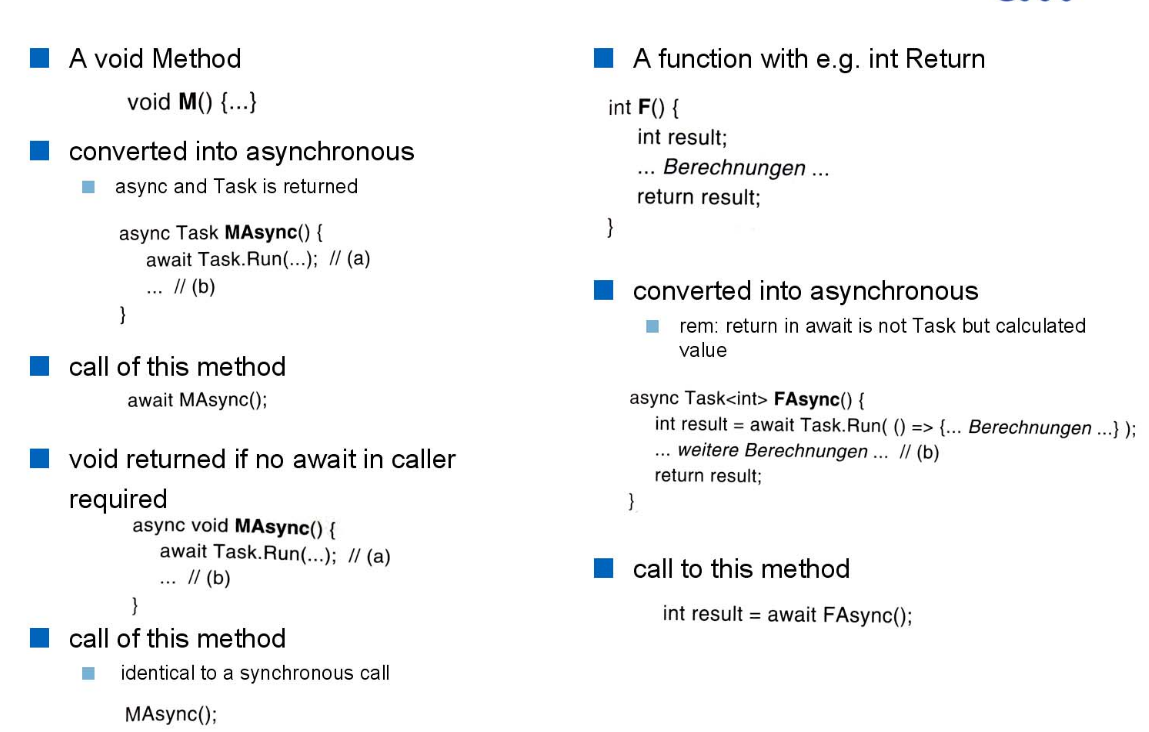
How to Convert
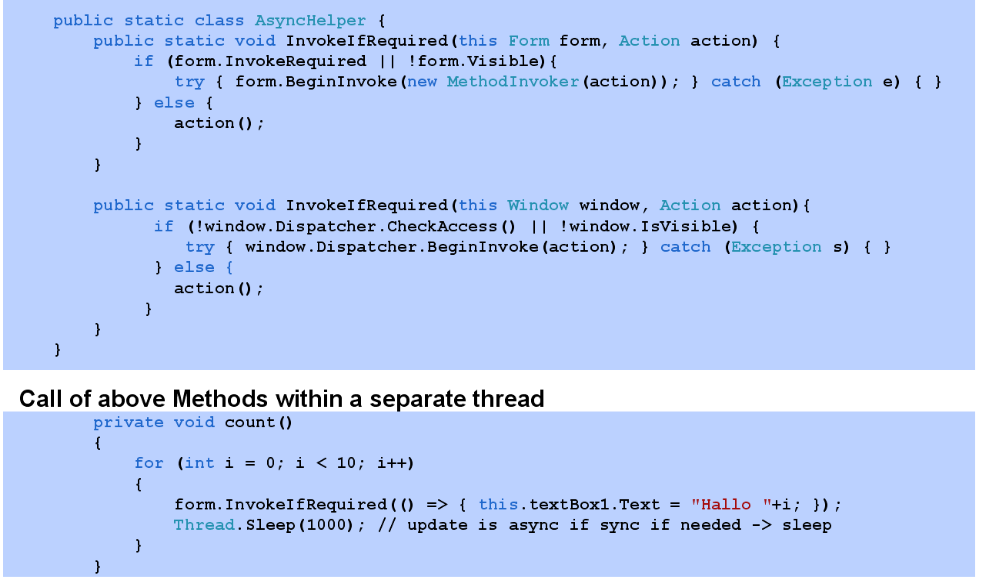
GUI-Thread
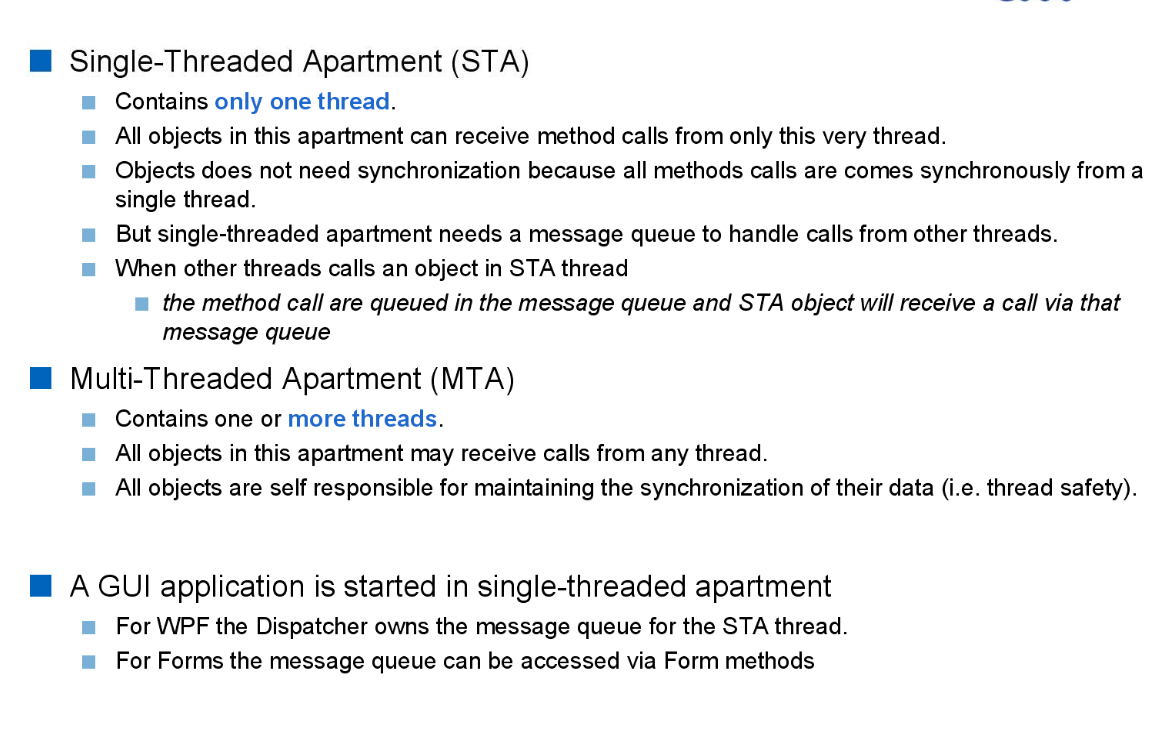
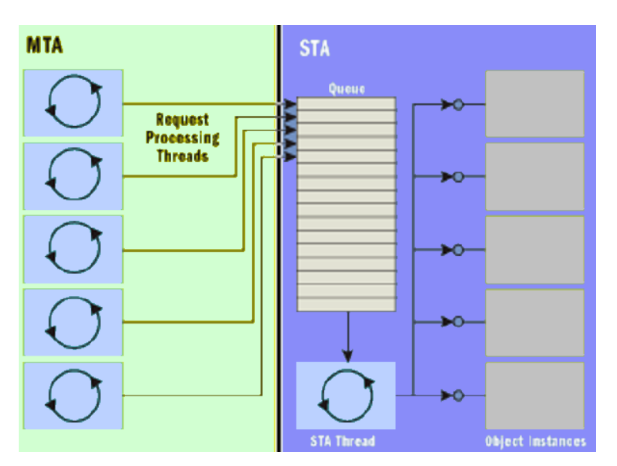
Um nun trotzdem mehrere Thread benützten zu können, müssen die Threads sich queuen im STA Thread.
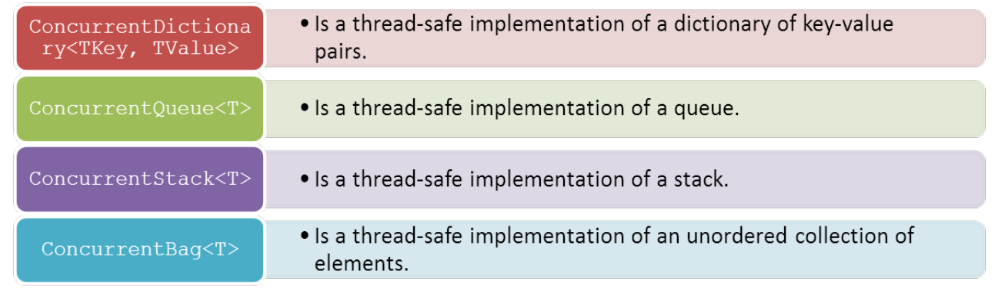
Concurrent Collections