Story Corp Interview
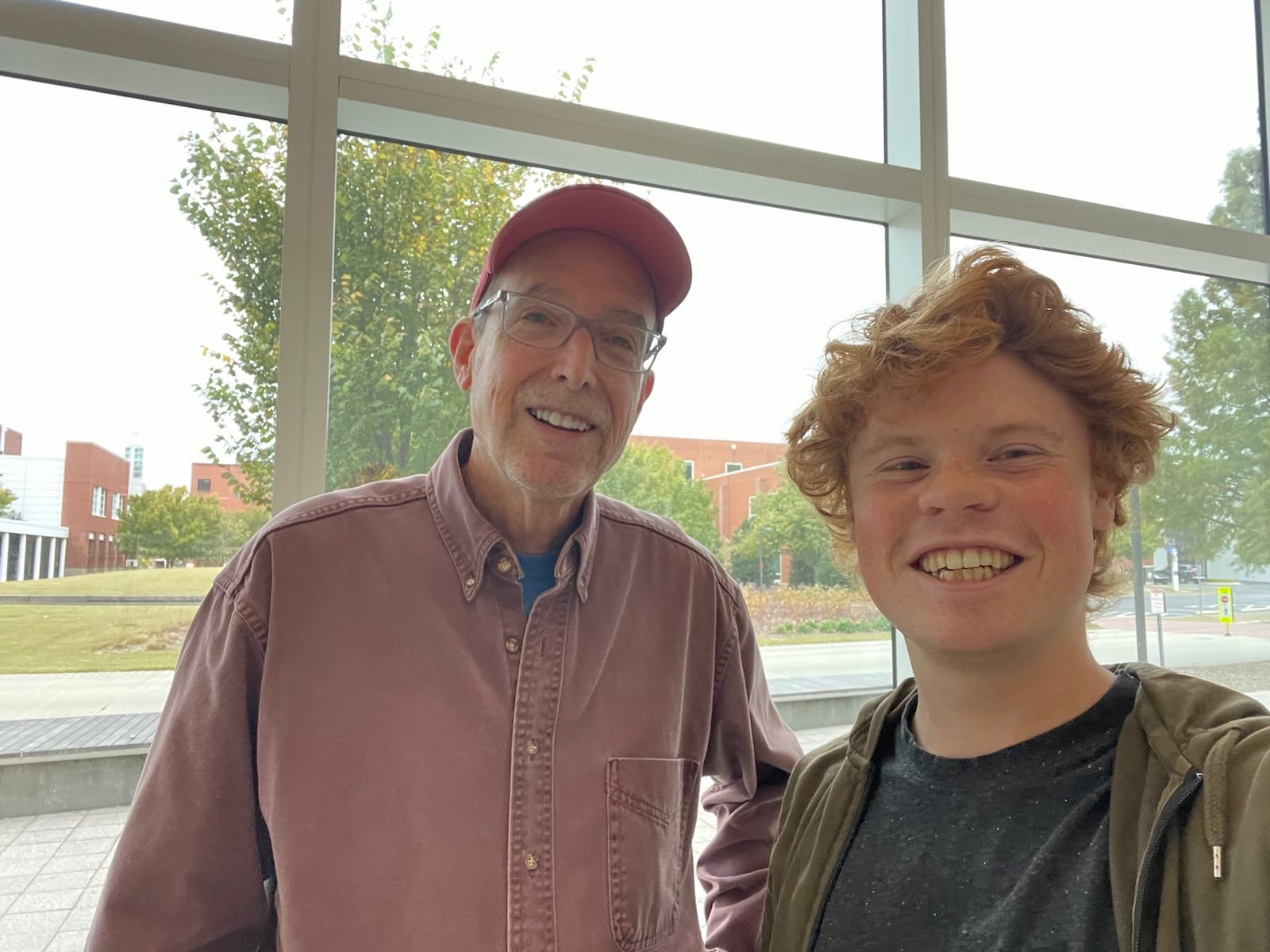
I interviewed Ray Easterlin in the coffee shop at the James B. Hunt Jr. Library. The interview took about 45 minutes. There weren't complete break downs in the conversations. However, there were times where I struggled to keep the conversation going. A quick look at my question sheet always brought me back on track. Still, there are small gaps in there.
Questions
- How would you describe yourself? He was born in North Carolina, and grew up in South Carolina in Charlston. Later, he went to undergrad and grad school in South Carolina. He worked in higher education for 40 years, and the last 8 years at NC State. He retired last year and now does what ever seems like fun.
- What did you originally study? Undergrad: Sociology Major; Grad: in the field of higher education. For his undergrad studies, he wasn't sure what to study, so he chose a sociology major. To wards the end of his undergrad study, he found that he wanted to work in higher education and help others with their studies and careers.
- Jazz Club? He volunteers at the non-profit jazz clubs, the Sharp 9/Durum Workshop. Interestingly enough, he isn't a musician. Right when he was retiring, he overheard them saying that they need more volunteers. He is usually the dorm man, taking the tickets.
- How did you grow to like Jazz? He used to watch famous jazz musicians on TV. Later, during collage, there was a jazz bar close by where he used to go often.
- What Sports are you playing? He always have played tennis.
- Was retiring a big change? He cut back a year prior to retiring. He mentioned that he felt that it was the right time. He is also in the life long learning program at NC State, where he has some fun classes (e.g. about base ball talk). Additionally, he does some volunteer work for a church to help people to with their resumes and job search
- What kind of people show up for that?
- Is it different from what students needed or are there similarities? There are a lot of similarities. The main difference is that they already have experience, but also bills to pay and worried.
- He mentioned that over 70% of the jobs are not advertised, but rather are given to internal people (like part-time, internships or people in different position). Furthermore, people who are refered do a better job and stay longer.
- How did you like school while growing up? High school was alright. He found it frustrating that he didn't know what to do and others seem to have it figured out. However, with hindsight, this was not the case. When he eventually figured it out and went to grad school, he became a more serious student because he had a direction and a goal
- Did you see that reflected in your grades? - Yes
- Was sociology as interesting as you initially thought?
- Did that later help you with education? Sociology helps you understand people who are different from your self?
- What is a job you'd get after studying sociology? Social worker
- How did your life turn out differently than you thought when you were younger? He moved more than he thought he would. Moving was his choice. (However, it seems to me that he always moved because of his job)
- How did you start to play tennis?
- How did these relationships hold up, while you was moving around? He always stay in touch
- Was moving also a curiosity to see something new or was it "just" job related? It was just job related. In the field of higher education, one has to move to climb the latter, since a lot of people stick around. He moved to get climb the latter and get a new challenge.
- Have you always lived in the south?
- What are differences and similarities between the different regions? On this topic, he mentioned that Austin is a very progressive city, which surprised me, since Texas as a hole is more conservative. He explains this with that a lot of people move to Austin for a job.
- Did you ever not like the people where you lived? No. He moved on because the job changed or he was just ready to move on.
- What are the most proud of? He is proud of having found a profession and being able to earn a living for his family. He also found something he enjoyed to do and stay challenged.
- What are some new challenges ahead of you?
- Have you travelled a lot in the States? While working in Texas he travelled a lot for work to go to conferences. Additionally, he managed employer relationships and he would visits potential employers of students.
- What kind of people attend the live long learning program? A lot of retired people, since it is usually offered just during the day.
Thoughts/Notes/Surprises
Something I found interesting about him and his life is how much of it has been defined by his work. He seems to be very proud of what he archived in his working life and how this allowed him to support his family. I think this is supported by the fact that he moved multiple times because of work and to be challenged at work.
To balance the job, he always played tennis. This also allowed to him to meet new people, sometimes even international ones.
Speech Artefacts
- "You ought to meet this person" \(\to\) You oughdameet this person
- "They prefer it" \(\to\) They preferid
- "Talking baseball class" \(\to\) Talkin baseball class
Unknown Words: Juvenile
Quote
I did find it frustrating that I didn't know what I wanted to do, 'cause it seemed like it - but this was not the case - but it seemed like a lot of people already had it all figured out, and I didn't.
I really like this quote, because I think a lot of people struggle with finding their purpose in life and it does seem like everybody else already know what to do.
Additionally, he did eventually find his purpose which made him a better student, and probably explains partly why he feels so passionately about his work.
Reflection
Overall, the interview went well. I was mostly able to continue with a different related question after my interviewee has responded. When I didn't know how to continue, a quick glance to my prepared questions got my back on track. Ray Easterlin was also a good interviewee and responded with enough details to paint a picture.
As to if I would want to do it again, I certainly enjoyed the experience. However with all the preparation and planing involved, I don't see my self changing my career planing any time soon.